
U.S. Listings Resource Center
Korean Companies and the U.S. Listing Window
Part of the AUM guide: IPO & Public Company Readiness
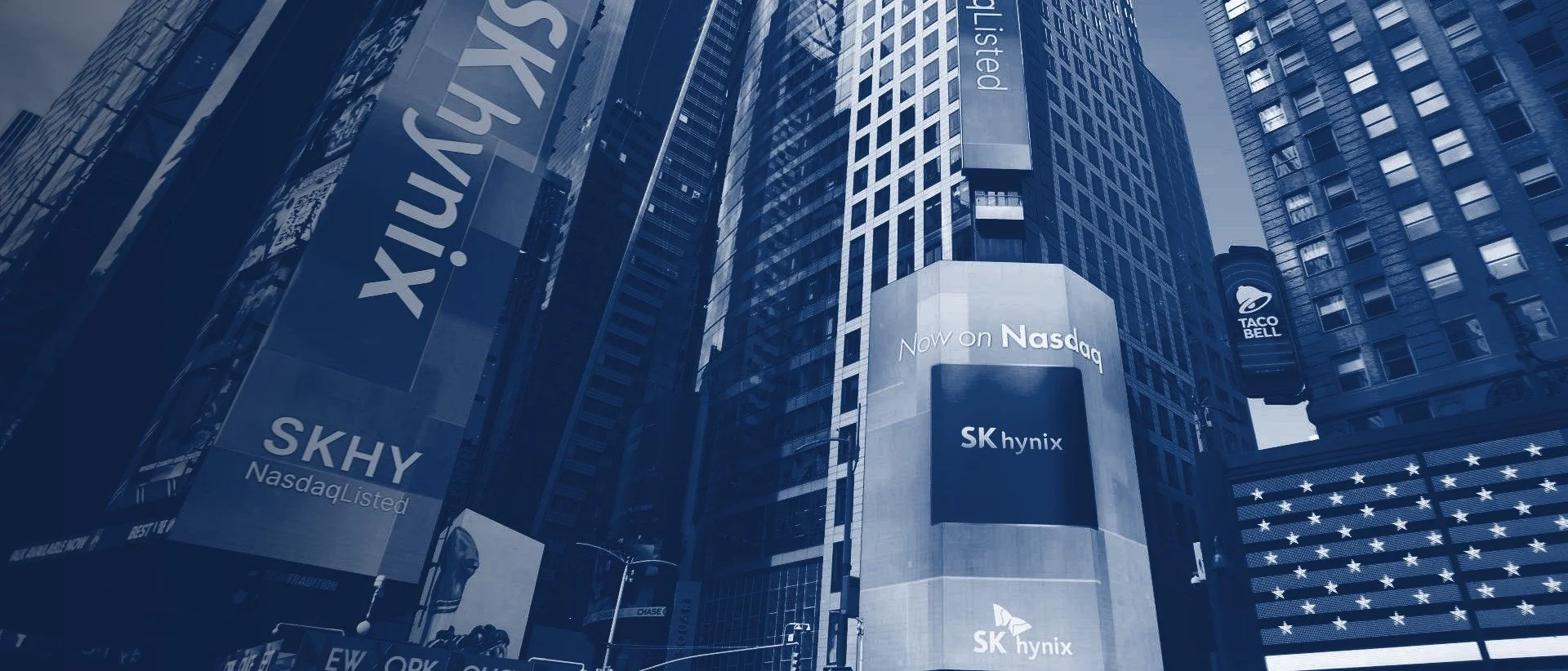
On July 10, 2026, SK Hynix rang the Nasdaq opening bell — a $26.5 billion ADR offering, the first by a KRX-listed company in more than two decades, and the largest share sale by a non-U.S. company in history. One deal did not create the corridor, but it proved the corridor to every Korean board that had filed the idea under “someday”: the U.S. market is open, and it prices Korean champions the way it prices their global peers.
Since then the question in Seoul boardrooms has shifted from whether a U.S. listing is possible to which path fits — and the honest answer depends on what you are raising, who holds your shares today, and how ready your reporting is. This page covers all three, from the capital-markets seat.
Why the U.S. Market — Three Reasons That Survive Scrutiny
- Valuation on global comps. A U.S. listing prices the company against the world’s deepest pool of sector peers and growth investors — semiconductors, AI, robotics, biotech — rather than a domestic index.
- Follow-on capital, on demand. The first raise is the beginning: follow-ons, PIPEs, converts, and at-the-market programs keep funding the plan as milestones land.
- Visibility and currency. Research coverage, index eligibility, and a liquid U.S. stock — a currency for M&A, partnerships, and talent worldwide.
Three Paths for a Korean Issuer
A traditional IPO with American Depositary Shares is the SK Hynix model for companies already listed on the KRX, and the conventional route for private companies raising primary capital. The full process — timeline, team, and the quiet period — is covered in our guide: The U.S. IPO Timeline — and the Team That Runs It.
A SPAC merger trades the market-window risk of an IPO for a negotiated price and a faster certain close — when the sponsor, the trust, and the PIPE are right. It is the route we examined in depth at the GoIPO Nasdaq Seminar in Seoul, and the economics are knowable in advance: our quarterly De-SPAC Scorecard publishes how these deals actually trade.
A direct listing suits companies that need liquidity and a public currency more than new capital — no underwritten offering, no dilution, and a different readiness bar. Fewer Korean companies know this door exists; it is open.
The Structural Advantage: Foreign Private Issuer Status
Nearly every Korean issuer qualifies as a foreign private issuer — registration on Form F-1, annual reporting on Form 20-F, market updates on Form 6-K, and exemptions that materially lighten the first years as a public company. Smaller issuers stack emerging growth company treatment on top: confidential filing, two years of audited financials, testing-the-waters meetings. The full analysis, including the 2026 changes to insider reporting: Foreign Private Issuer Status.
Structure is the first advisory conversation, not a formality. A KRX-listed company can follow the ADR route on the Korean entity; a private company weighs a direct Korean listing against an offshore holding company, and the answer drives tax, FPI status, and timeline. Coupang’s 2021 NYSE debut through a Delaware parent is the instantly recognized contrast — a structure that made it a domestic U.S. filer, with the full 10-K and 10-Q regime that entails. Same country of operations; a different answer on structure; a different regulatory life afterward.
What Korean Issuers Underestimate
The audit is the long pole that sets the pace of every listing path. K-IFRS keeps Korean issuers close to the IFRS-as-issued-by-the-IASB basis that FPIs may file on — a meaningfully shorter bridge than a full U.S. GAAP conversion — but PCAOB audit standards, auditor independence rules, and the audit package still set the calendar.
The second underestimate is English-language investor relations: the disclosure calendar, the earnings call, the analyst day, and the first-year program all run in English for an investor base that has never visited the plant. That function must exist before the first filing — it is where we live.
AUM in the Corridor
We presented “SPAC Mergers: An Alternate Route to Nasdaq” at the GoIPO Nasdaq Seminar 2026 at COEX in Seoul — in English and Korean — alongside sessions from the auditors and counsel who build these deals. Our team has counseled 100+ IPOs and SPACs across the U.S., Japan, Europe, and Asia, and works from the issuer’s seat: readiness against investor expectations, the equity story, structure and venue advice with no economics tied to any single path, and the first-year program that decides what the listing was worth.
Frequently Asked Questions
Can a KRX-listed company also list in the U.S.? Yes — via American Depositary Shares on the Korean entity, the SK Hynix route. The dual-listing weighs home-market liquidity against U.S. comps and follow-on access.
Does a Korean company qualify as a foreign private issuer? Nearly always, if organized in Korea with a predominantly non-U.S. register — tested annually. FPI status is the single biggest structural advantage over U.S.-domiciled peers.
IPO, SPAC, or direct listing — which fits? Raising primary capital at scale: IPO. Negotiated price and speed, with the right sponsor: SPAC. Liquidity without dilution: direct listing. The readiness bar is the same height for all three.
How long does it take? With a substantially complete PCAOB audit, roughly 135–160 days from kickoff to pricing; from a standing start, 9–18 months. The audit, not the SEC, is usually the long pole.
Do we report in Korean or English? SEC filings are in English; most Korean issuers run a bilingual program — English for the market of record, Korean for the home register and media.
Related Resources
- IPO & Public Company Readiness
- Foreign Private Issuer Status
- Three Paths to a U.S. Listing
- The De-SPAC Scorecard
The window is open. The companies that use it will be the ones that started preparing before their bankers called.
Talk to AUM