

AUM Advisors Insights
THE DE-SPAC SCORECARD | H1 2026
Redemptions, PIPEs, and the Widening Gap Between Winners and Losers
Crocker Coulson | CEO, AUM Advisors
July 2026 | The first in a quarterly series
Source: SPAC Insider/AUM Advisors analysis. Market data as of July 9, 2026.
Every quarter, a familiar stack of investment bank decks tallies SPAC IPO issuance — how many blank checks priced, how big the trusts, which sponsors are back. Almost nobody tracks what happens after the merger closes. The reason is uncomfortable: roughly 85% of completed de-SPACs have destroyed value, and the industry would rather count launches than landings.
We take the opposite view. In our June study, The Five Disciplines of De-SPAC Success, we analyzed all 699 completed de-SPAC transactions since 2010 and found that the roughly one in seven that succeed share identifiable, repeatable disciplines. This Scorecard extends that work forward in real time: an unbiased, data-first review of every de-SPAC that closed or was announced in the first half of 2026 — the winners, the casualties, and what separates them.
The headline finding: the post-reform bifurcation we identified in the whitepaper is accelerating. Of the 24 de-SPACs completed in H1 2026, seven — 29% — trade above the $10.00 IPO price, nearly double the 15% outperformance rate across the full 699-deal historical universe. The catastrophes are still catastrophic. But the deals that work are working faster, and the market is sorting them with remarkable speed — pricing the announced pipeline almost exactly at cash and reserving genuine premiums for a chosen few.
Part I: The Announced Pipeline — The Market Prices Deals at Cash
Forty-seven de-SPAC transactions announced in H1 2026 were still pending as of this writing. The single most useful real-time indicator for a pending deal is where the SPAC's shares trade relative to what a holder would receive by redeeming their shares for cash. But that comparison is only as good as its denominator. Most commentary measures the premium against the $10.00 held in trust at IPO — a number that flatters every seasoned vehicle, because trusts accrue interest at roughly the Treasury bill rate from the day they are funded. We measure instead against current implied cash per share, which reflects the trust as it stands today.
AUM Advisors | The De-SPAC Scorecard | H1 2026 1
The correction changes the picture entirely. Measured against trust at IPO, 19 of 47 announced deals — 40% — appear to trade more than 5% above trust. Measured against current redemption value, just 3 of 47 do. The median announced deal trades 0.8% below its cash value, and 38 of the 47 sit within ±2% of it.
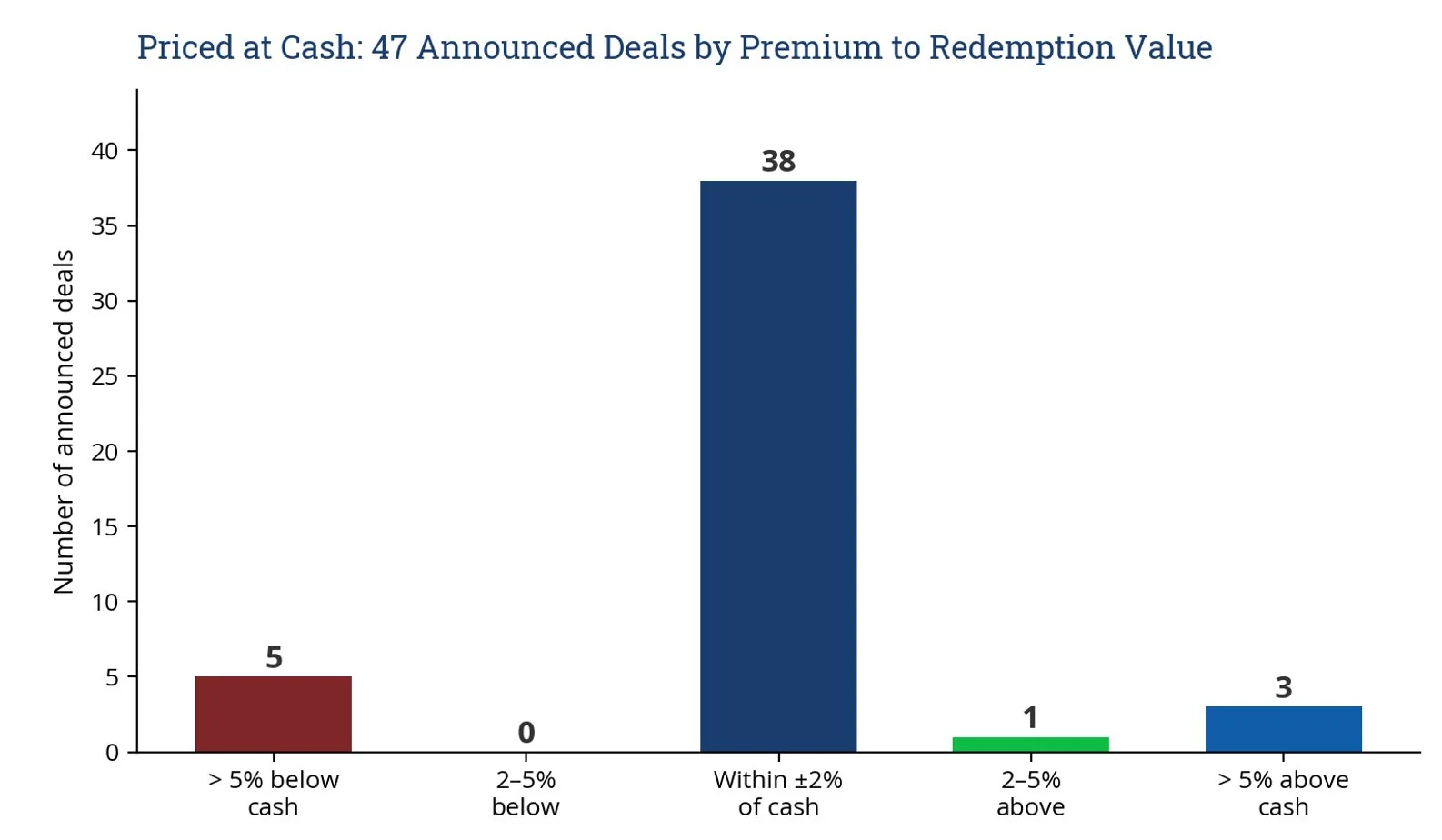
Figure 1. Announced H1 2026 de-SPACs by premium to current redemption value. Source: SPAC Insider; AUM Advisors analysis.
The seasoned vehicles make the point vividly. A 2021-vintage SPAC in the pipeline shows a +31% premium against its original $10.00 — and trades 8% below its actual redemption value of $14.24 once five years of accrued interest are counted. The five deals trading more than 5% below cash are all seasoned vehicles or visibly troubled transactions, where the discount prices deal-break risk and illiquidity rather than opportunity.
Genuine conviction is rare and concentrated: Churchill Capital Corp XI / Agility Robotics at roughly +50% above redemption value and Talawar Therapeutics at +19%, with ZincFive just clearing the 5% line. That is roughly one deal in fifteen commanding a real premium before closing — against the 15% of completed de-SPACs that have historically created value. The market’s default answer to an announced de-SPAC continues to be “I’ll take the cash, thanks.” Investors are underwriting the equity story early in only a handful of standout names.
PIPEs in the Announced Pipeline
Six out of the 47 announced deals have disclosed committed PIPE financing, totaling roughly $776 million and ranging from a nominal $1 million to $225 million. Four of the six are straight common equity at $10.00. Two carry warrant coverage of 1.0 to 1.5 warrants per unit — which we classify as structured financing, along with any convertible instrument, variable price reset, or arrangement in which the sponsor transfers “free” sponsor shares as a kicker to investors. It is no coincidence that the two deals commanding double-digit premiums both come with large, committed PIPEs ($200 million and $225 million). Committed capital and market conviction are often paired, a pattern the completed-deal data in Part II confirms emphatically.
Looking at sector composition: technology accounts for 20 of the 47 announced targets — 43% of the pipeline — followed by renewable energy and grid infrastructure with eight. On the corrected premium basis, no sector commands a systematic premium. Conviction remains deal-specific, not thematic. A crowded category buys an assured listing, but not necessarily an investor bid.
Part II: Completed Deals — The Value Sorting Machine
Twenty-four de-SPAC transactions closed in the first half of 2026. Viewed one way, the cohort looks familiar: the median deal trades at $7.04, down roughly 30% from the $10.00 IPO price. Viewed another way, something has changed. Seven of the 24 trade above $10 — and four of those seven are quantum computing companies. The clearest sector casualty is crypto: the half’s four digital-asset de-SPACs — two token treasury vehicles, a crypto asset manager, and a tokenization platform — trade at a median of roughly -70%, with none above $10.
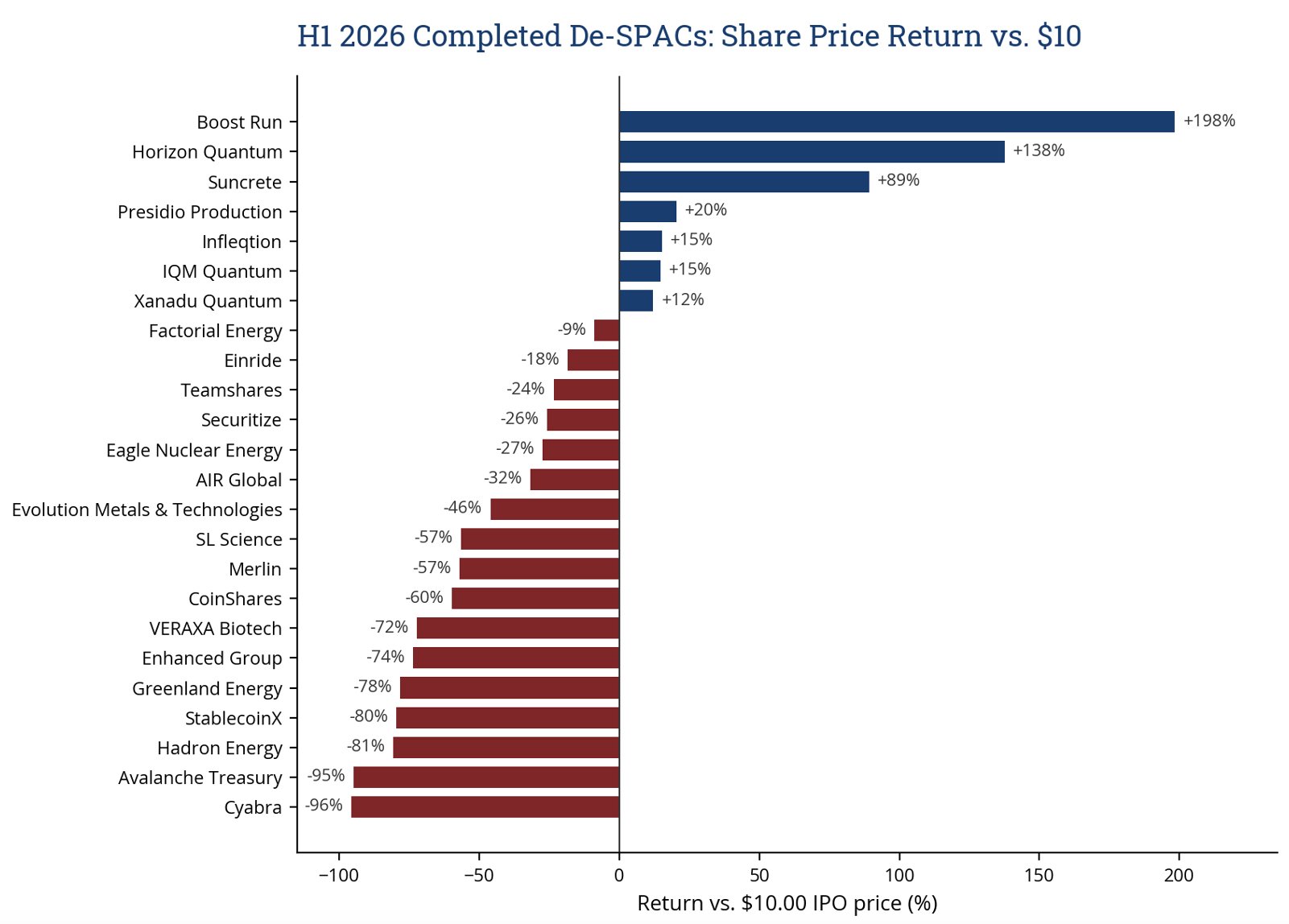
Figure 2. Share price return vs. $10.00 IPO price for all 24 de-SPACs completed in H1 2026. Source: SPAC Insider; AUM Advisors analysis.
Redemptions: Still a Referendum, Still Brutal
The median completed deal saw 89% of trust shares redeemed, and half the cohort — 12 of 24 deals — lost more than 90% of trust to redemptions. The mean of 77% is flattered by a handful of remarkable outliers: two deals closed with zero redemptions (Boost Run and IQM Quantum Computers), and Infleqtion retained essentially its full trust at 0.09% redeemed.
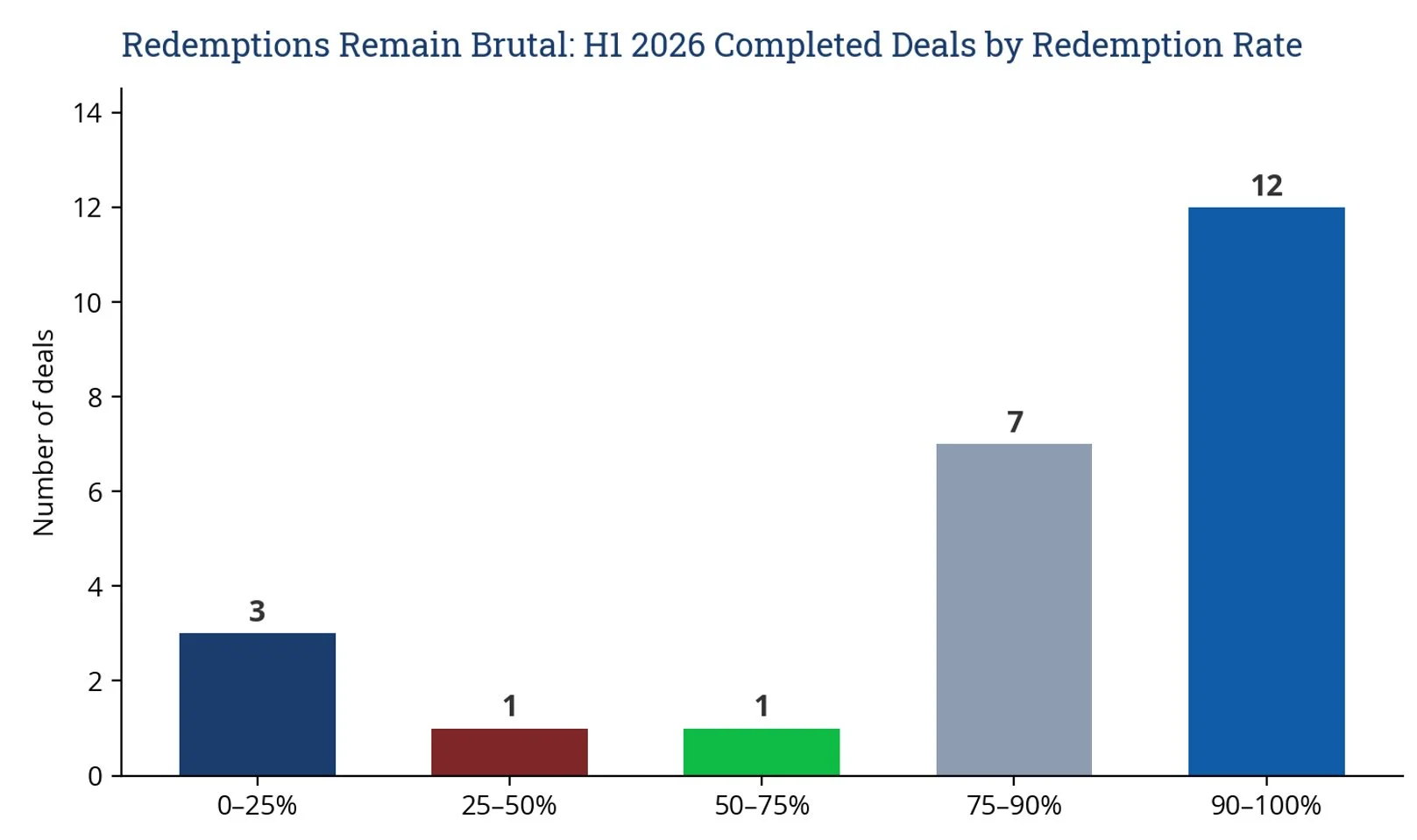
Figure 3. Distribution of redemption rates across H1 2026 completed de-SPACs. Source: SPAC Insider; AUM Advisors analysis.
The redemption vote has become the market's most honest referendum on deal quality. Every one of the three lowest-redemption deals trades above $10 today. Of the twelve deals that redeemed more than 90% of trust, exactly one trades above the IPO price; of the twelve that held redemptions at or below 90%, half do. Public SPAC holders, so often caricatured as yield-farming arbitrageurs, are proving to be rather adept at valuing these companies — at least the investors who remain holders at the redemption notice date.
PIPEs: The New Trust
Sixteen of the 24 completed deals — two-thirds — closed with PIPE financing, totaling $2.7 billion for the half. The median PIPE was $120 million; the mean of $169 million is skewed by a single $893 million outlier (StablecoinX). With median redemptions at 89%, the practical reality is that PIPEs are no longer supplementing trust capital — they are replacing it. The trust has become a listing mechanism; the PIPE is the actual financing.
Structure remains the exception, not the rule: 12 of the 16 closed PIPEs were straight equity at or near $10.00, while four carried structure — discounted ADSs with warrant coverage, units, or packages combining equity with convertible notes and preferred. The performance gap is instructive. The four structured deals trade at a median of roughly -57%, while the straight-equity cohort is essentially flat at a median of +2%. Structure is what a deal accepts when clean capital gives a pass, and the aftermarket trades the stock accordingly.
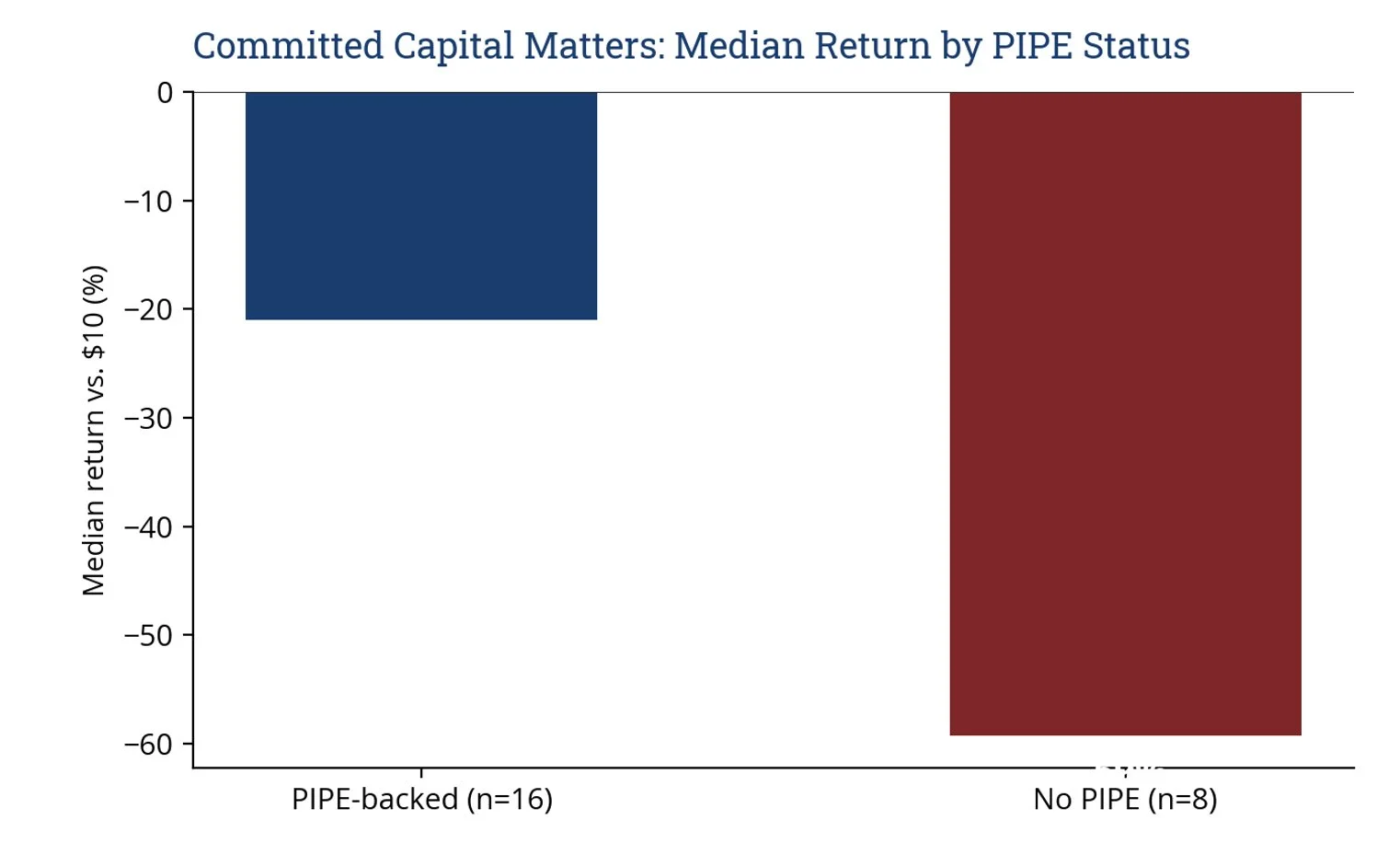
Figure 4. Median return vs. $10.00 by PIPE status, H1 2026 completed deals. Source: SPAC Insider; AUM Advisors analysis.
The starker split is simply having institutional capital at all. PIPE-backed deals trade at a median of -21%; deals that closed without a PIPE trade at a median of -59%. Committed institutional capital is simultaneously validation, float, and runway — and its absence is now close to disqualifying.
The Winners
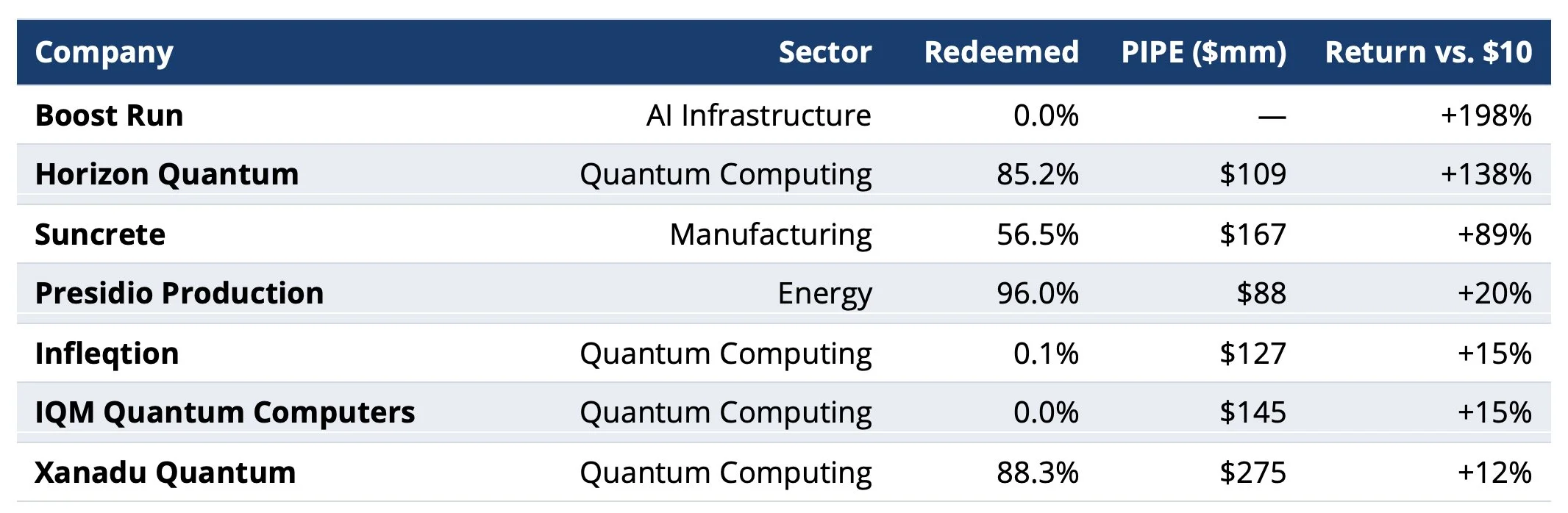
Table 1. H1 2026 completed de-SPACs trading above the $10.00 IPO price. Source: SPAC Insider; AUM Advisors analysis.
Four of the seven winners are quantum computing companies — Horizon Quantum, Infleqtion, IQM, and Xanadu — and every one of them closed with a PIPE of $100 million or more. The quantum cohort is the clearest expression of the scarcity premium in today's market: a small number of genuinely differentiated, deep-science assets that public investors cannot access any other way. IQM, the Finnish quantum hardware leader, closed on July 1 with zero redemptions and an upsized $145 million PIPE that brought in Finnish pension institution Ilmarinen alongside existing holders — a model of how a European deep-tech company can use the de-SPAC route to reach US capital with institutional validation intact. Whether every quantum valuation proves durable is a question for the coming quarters; that the market is differentiating real technology platforms from story stocks is not.
Part III: Three Case Studies
Horizon Quantum: The Premium PIPE
On paper, dMY Squared's merger with Singapore-based Horizon Quantum looked like a redemption casualty: 85% of trust shares redeemed, leaving roughly $11 million of cash. What the redemption number missed was the quality of the capital that stayed and arrived. The $109 million PIPE priced at $11.82 — a premium to trust value — with an 18-month lockup and strategic participation from IonQ, the most successful quantum de-SPAC of the prior generation. A PIPE priced above NAV with long lockups is the single strongest signal a de-SPAC can send: sophisticated investors underwriting the long-term equity story with conviction. The stock trades near $24, up 138%.
Suncrete: The Full Toolkit
Haymaker Acquisition Corp. 4's merger with Suncrete shows what disciplined deal engineering looks like in the post-reform era. A private equity–backed roll-up of Sunbelt ready-mix concrete operations — a real industrial business with substantial revenue, consolidating a fragmented, mission-critical industry in the middle of a generational ownership transfer. Redemptions held to 56.5% — dramatically below the 89% median. A PIPE upsized from $105 million to $167 million on demand, layered with $51 million in non-redemption agreements and a $58 million forward purchase commitment. And within weeks of closing, a warrant exchange offer that cleaned up the capital structure — removing the overhang that has suppressed so many post-merger equities. Every one of the Five Disciplines is visible here, and the market has paid for it: +89%. Suncrete may also preview where the next cohort of winners comes from: cash-generative consolidation platforms in unglamorous sectors, where a public currency is an acquisition tool rather than an exit.
StablecoinX: Capital Is Not a Strategy
The largest PIPE of the half — $893 million, from a roster of prominent crypto investors — belongs to a deal trading down roughly 80%. TLGY Acquisition's combination with StablecoinX, a digital-asset treasury vehicle, closed in June with 99.6% of trust redeemed after a four-and-a-half-year SPAC life spanning eight extensions and a terminated prior deal. The lesson is one the 2021 cohort taught and the market keeps re-learning: capital raised is not value created. A nine-figure PIPE can fund a balance sheet, but it cannot substitute for a compounding operating story that gives public investors a reason to hold. The de-SPACs that work are businesses first and financings second.
At the other end of the capitalization spectrum sits the half's worst performer: an $8 million PIPE atop a $1.5 million post-redemption trust, now trading down 96%. Undercapitalized deals do not get a second chance in this market.
Part IV: League Tables and Geography
Financial Advisors
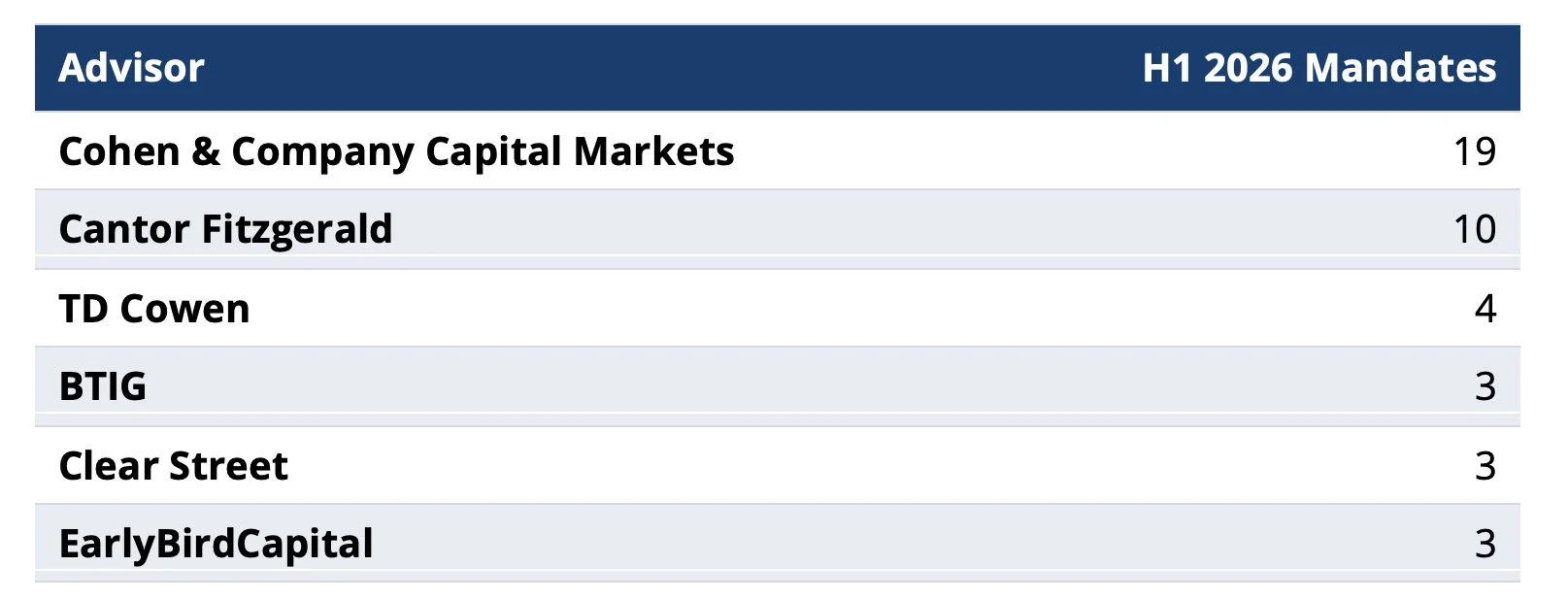
Table 2. Financial advisory mandates across announced and completed H1 2026 de-SPAC transactions (buy-side and sell-side combined). Source: SPAC Insider; AUM Advisors analysis.
Legal Advisors
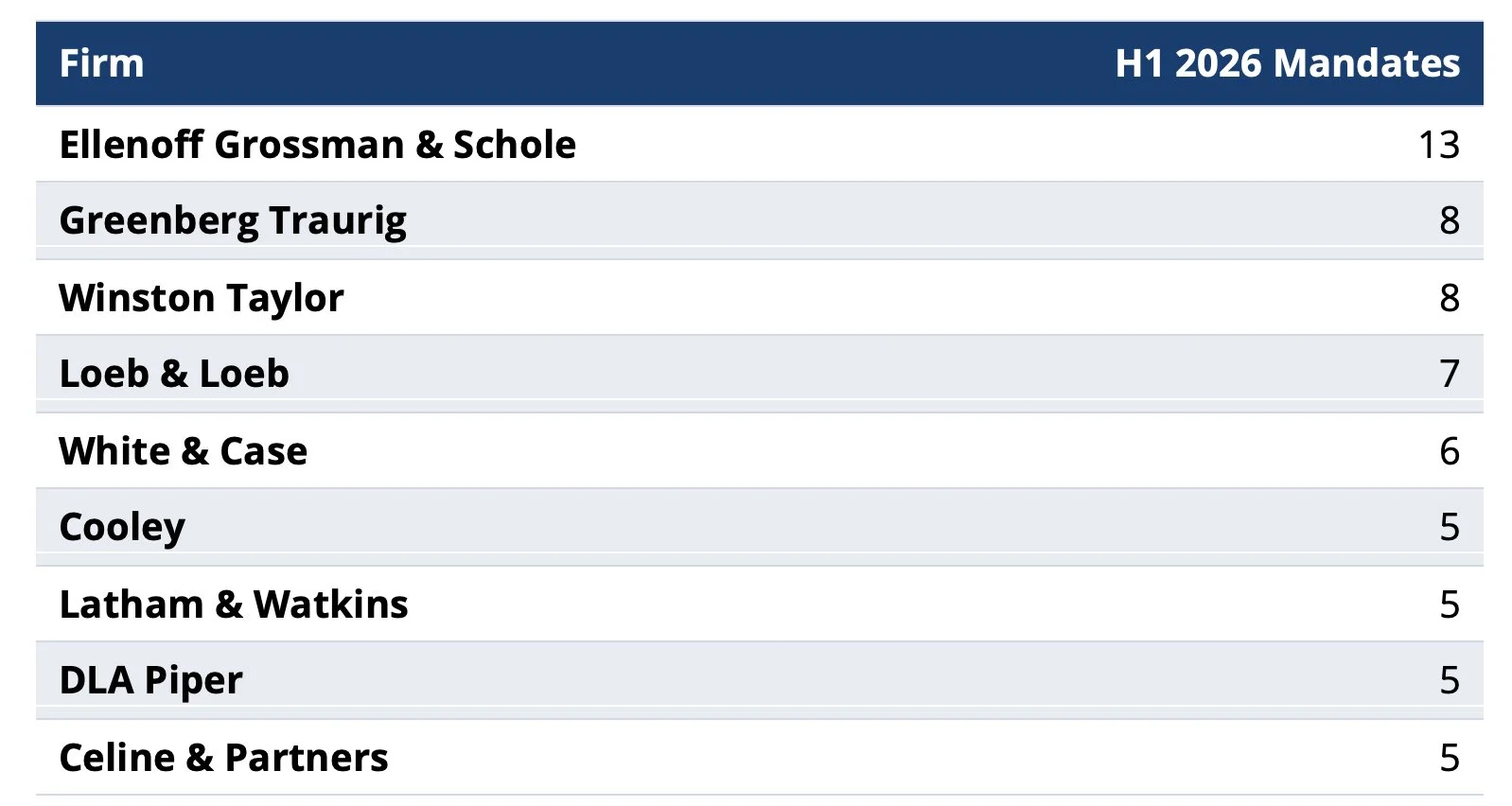
Table 3. Legal advisory mandates across announced and completed H1 2026 de-SPAC transactions (all deal roles combined). Source: SPAC Insider; AUM Advisors analysis.
Geography: The Cross-Border Half
Perhaps the most underappreciated feature of the current cycle: 43% of announced H1 2026 targets — 20 of 47 — are headquartered outside the United States, spanning eight European targets (France, Switzerland, the UK, Ireland, the Netherlands, Poland), eight across Asia-Pacific (Hong Kong, Singapore, Taiwan, South Korea, Australia), three in Canada, and one in the Middle East. Among completed deals, nine of 24 targets were international — including the half's Finnish, Singaporean, and Canadian quantum winners. The de-SPAC has quietly become one of the principal on-ramps for international companies seeking US listings, valuations, and liquidity — a theme we expect to strengthen as European critical minerals, defense technology, and deep-science companies weigh their venue options.
What It Means
Three conclusions from the first half, each of which we will test again in Q3:
1. The bifurcation is real and accelerating. A 29% above-$10 rate — against a 15% historical base — does not mean de-SPACs have become safe. It means the market has become more efficient at sorting them, and the sorting now happens early: in the redemption vote, in the PIPE book, and in the premium to redemption value before closing.
2. The PIPE is the deal. With trusts redeeming away at a median of 89%, committed institutional capital has become the de facto financing event, the validation signal, and the strongest single predictor of aftermarket performance in our H1 data. Terms matter as much as size: straight equity at or above trust is a vote of confidence; structure is a warning label.
3. Scarcity beats supply. In completed-deal performance, the winners are concentrated in assets public markets cannot otherwise reach: quantum computing platforms, differentiated deep science, and international leaders making their US debut — plus, in Suncrete’s case, a cash-generative industrial consolidator. In the announced pipeline, conviction premiums attach to two names — a category-defining robotics platform and a clinical-stage biotech — while the crowded middle trades at cash. Scarcity earns a bid; supply earns a listing.
The Scorecard will return after the third quarter with the same lens: not how many SPACs launched, but which combinations created value — and why.
About AUM Advisors
AUM Advisors is a senior investor relations and capital markets advisory firm specializing in international issuers and complex US capital markets situations, including the full SPAC lifecycle from vehicle formation through the first year as a public company. Methodology note: transaction data from SPAC Insider; classifications and analysis by AUM Advisors. "Structured" PIPEs include convertible instruments, discounted or variable pricing, warrant coverage, and arrangements involving sponsor share transfers to investors. Returns measured against the $10.00 SPAC IPO price, split-adjusted. Announced-deal premiums measured against SPAC Insider’s current implied cash per share (latest trust filings), not trust value at IPO. Nothing in this report is investment advice.