
U.S. Listings Resource Center
IPO & Public Company Readiness
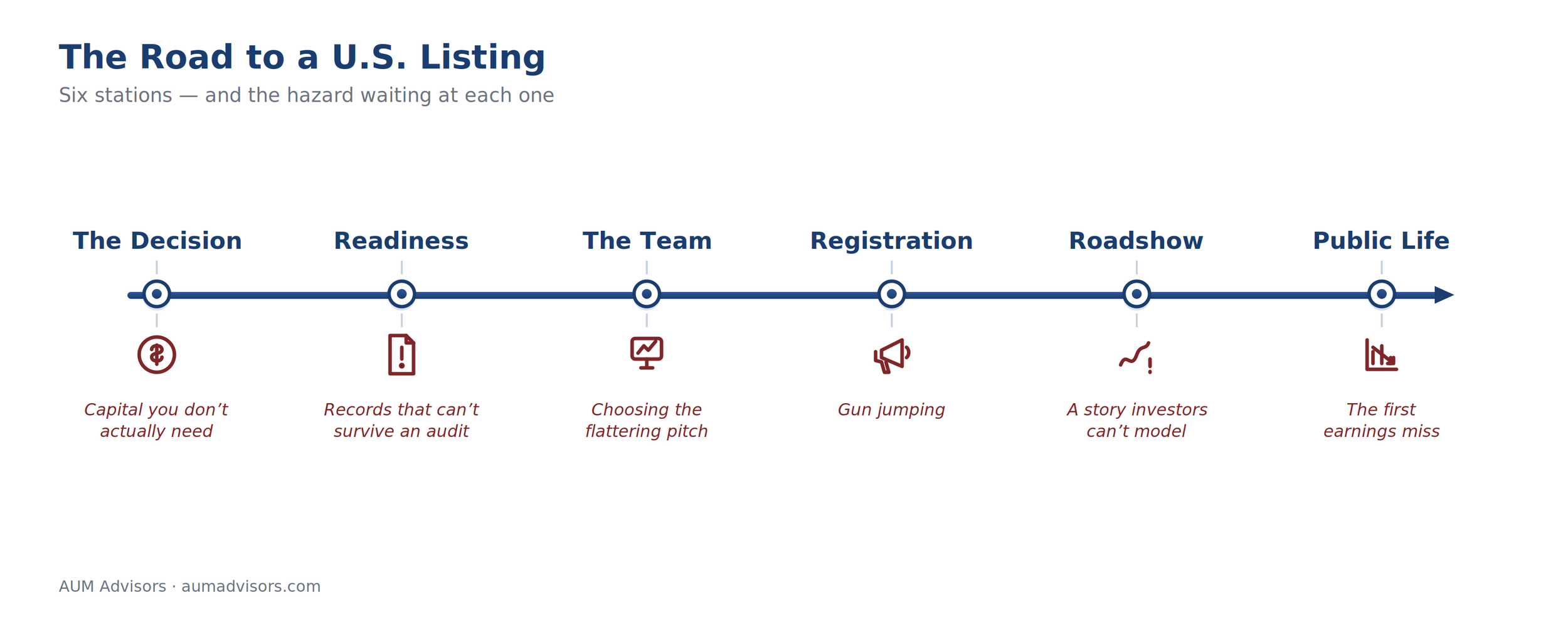
Going public in the U.S. is the most consequential financing decision most companies will ever make — and the most mythologized. Plenty of advisors will sell you the opening bell. Far fewer will tell you what the eighteen months before it demands from the management team or that the bell is the starting line: from that morning on, your company carries a price that reprices every trading day, graded by people you have never met. Companies that prepare for the offering but not for the aftermath routinely give back in year one the valuation that they fought for at pricing.
AUM Advisors prepares international companies for both — the listing and the life that follows. This guide covers the decision, the team, the timeline, the costs, and the first year of being public, from the capital-markets seat rather than the accounting one.
First Question: Should You List at All?
An IPO is one financing tool among several, and not always the right one. Before committing resources, answer five questions without an advisor in the room:
- Does the capital plan require public equity — or would a late-stage private round, debt, or a strategic sale serve the same goal with less cost and exposure?
- Can overseas institutional investors understand your business in one meeting, with data they can verify?
- Will your results bear quarterly forecasting — or are they still too volatile to model with confidence?
- Is the management bench deep enough to run the company and run being public, which is close to a second full-time job?
- Are you prepared to disclose — to investors, competitors, and regulators alike — at the level U.S. securities law demands?
A weak answer to any of them simply defines the work plan. A company that lists before it can answer them tends to become a cautionary comp in somebody else's pitch deck.
What "IPO Ready" Means in Practice
Readiness is four things, and bankers will test all of them before they commit a cent of reputation to your deal:
- an investment thesis that investors can model, not just admire;
- financial statements that survive an audit and an SEC comment letter;
- a management team and board built for public scrutiny, with the CFO as the most examined hire you will make;
- and a communications function that exists before the registration statement is filed, not after the bell rings.
The first three get most of the attention. The fourth is where we watch deals quietly fail — which is why it has its own chapter in this guide: The First Year of Being Public.
The Case for an Independent Advisor
Underwriters, counsel, and auditors each carry a defined mandate: the order book, the registration statement, and the integrity of the financial statements. Each is essential — and each is, properly, an advocate for its own workstream.
What a first-time issuer often lacks is an experienced advisor with no economic interest in any single outcome — one that has been through the process many times, works solely for the company, and can help management weigh the advice it receives, coordinate among the parties, and keep the preparation aligned with how institutional investors will actually judge the company: at the roadshow, at pricing, and in the quarters that follow. That is the role AUM aims to fill, in support of — never in place of — the banks, lawyers, and auditors. We conduct the readiness assessment against investor expectations, develop the equity story and the materials that carry it, help set disclosure and communications policy before the quiet period narrows the options, and stay with the company through the first year, when coverage, credibility, and liquidity are earned.
International Issuers Start with an Advantage
Most non-U.S. companies qualify as foreign private issuers — a status that meaningfully lightens the disclosure load: filings on F-1 rather than S-1, annual reporting on Form 20-F, exemptions from U.S. proxy rules and Regulation FD, and the choice of IFRS or U.S. GAAP. Smaller issuers can layer on emerging growth company treatment — confidential filing, two years of audited financials instead of three, and testing-the-waters meetings before committing to the full expense.
Used deliberately, these accommodations cut both the timeline and the bill. Used carelessly, they produce a company that reports less than its U.S.-listed peers and gets valued accordingly. See the full analysis: Foreign Private Issuer Status.
Frequently Asked Questions
How long does a U.S. IPO take? From organizational meeting to pricing, roughly 135–160 days if your audit is complete when you start; realistically 9–18 months from a standing start. The PCAOB audit, not the SEC review, is usually the long pole that extends deal timelines.
What does it cost? The underwriting discount is success-based; audit, legal, D&O, listing and filing fees are not, and survive an abandoned deal. See "What a U.S. IPO Actually Costs."
What is a foreign private issuer? A non-U.S. company meeting an ownership-and-management test that files on F-forms and reports on a lighter rhythm than domestic issuers. Most Asian and European listings in the U.S. use it.
When should the IR function exist? Before the first S-1 or F-1 draft. Communications during registration are regulated; a function invented after pricing starts the public life already behind.
Can we explore an IPO confidentially? Yes — EGCs and most FPIs can file draft registration statements confidentially and meet qualified investors to test demand before going public with the plan.
Related Resources
- Three Paths to a U.S. Listing
- Listing Guide for Japanese Companies Considering a U.S. IPO
- Listing via SPAC merger? Readiness still applies — see our SPAC & De-SPAC investor relations practice.
Planning a listing in the next 24 months? The readiness conversation is the cheapest part of the entire process.
Talk to AUM Advisors