
U.S. Listings Resource Center
What a U.S. IPO Actually Costs
Part of the AUM guide: IPO & Public Company Readiness
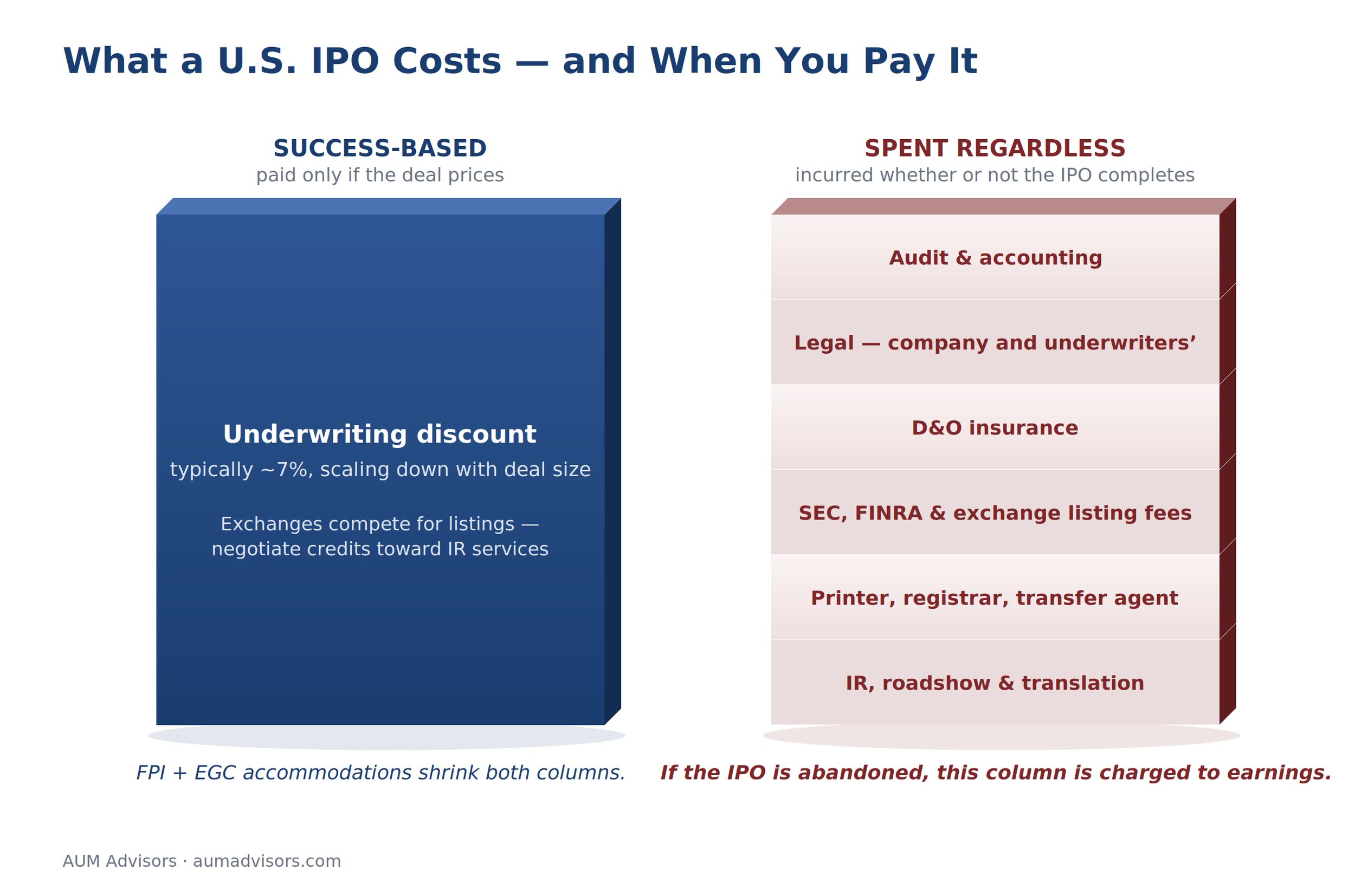
The headline cost of an IPO — the underwriting discount — is the one you only pay if the deal works. Much of the rest is spent whether it works or not. Budgeting a listing honestly means separating the two piles, because the second one is the real measure of what you are risking by starting.
Success-Based
The underwriters' discount — typically seven percent on offerings below roughly $150 million, negotiated into the five-to-six percent range as deal size grows, and lower still for the largest offerings. On smaller deals, banks frequently ask for underwriter warrants on top — commonly up to five percent of the shares sold, struck at a premium to the offer price — plus expense reimbursement, all of it reviewed by FINRA for fairness before the deal can proceed. AUM Advisors can help to negotiate terms in line with market norms and avoid provisions that will potentially undermine the company's future. Exchanges compete for listings hard enough that both Nasdaq and the NYSE will often credit part of your IR-related service costs into the listing package; ask, because nobody volunteers it.
Spent Regardless
- Audit and accounting — scale- and history-dependent, and the least compressible line: two to three years of PCAOB-standard audited financials, interim reviews, and, for most Asian issuers, accounting advisors to make the records auditable in the first place. Auditors are not permitted by PCAOB rules to defer fees until closing.
- Legal — both the company's counsel and, economically, the underwriters': registration statement, restructuring and housekeeping, diligence, negotiation.
- D&O insurance — essential, material, and priced to the litigation environment; get quotes early, not at pricing week.
- SEC and FINRA filing fees, initial and ongoing exchange listing fees.
- Financial printer, registrar, transfer agent — and depositary, for ADS structures.
- Investor relations — including roadshow travel, and — for many international issuers — translation and bilingual disclosure costs that domestic peers never see.
If the IPO completes, these costs capitalize into the offering. If it is abandoned, they land on the income statement — the quiet reason "window risk" is a financial-planning item, not just a market view.
Managing this budget is part of AUM's mandate. We track each workstream's fees against its engagement letter, benchmark terms against comparable completed deals, and help management negotiate with every provider — including which fees can be deferred, staged, or made contingent on completion — so the company optimizes its total cost and avoids the traps that routinely catch first-time issuers.
Where FPIs and EGCs Save
Two years of audited financials instead of three. Deferred internal-controls attestation. Aggregate rather than individual compensation disclosure. Confidential filing — which doesn't reduce the bill but protects sensitive data if the deal pauses. Used together, the accommodations take a meaningful fraction out of both the offering cost and the first years of public-company run-rate.
The Budget Nobody Shows You: Being Public
The offering budget ends at closing; the public-company budget never does. Annual audit, D&O renewal, independent director compensation, listing fees, IR, legal, and the internal finance headcount to produce timely statements — plan the run-rate alongside the offering, because investors will ask about it and the board will live with it.
Frequently Asked Questions
What's the single biggest cost? The underwriting discount if the deal prices; the audit if it doesn't.
What do we lose if we abandon the IPO? The non-success-based pile: audit, legal, D&O, filing fees, advisory — charged to earnings rather than capitalized.
Do exchanges really subsidize costs? They compete for listings; credits toward IR-related services are a normal part of the package if you negotiate for them.
Related Resources
- The U.S. IPO Timeline — and the Team That Runs It
- Foreign Private Issuer Status: The International Company's Edge
We'll help you build the honest budget before you commit to the timetable.
Talk to AUM