

AUM Advisors Insights
The Five Disciplines of De-SPAC Success
The Five Disciplines of De-SPAC Success
What 699 Transactions Teach Us About Who Wins — and Why 85% Fail
Crocker Coulson | Founder & CEO, AUM Advisors June 2026 | Prepared for the SPAC Conference, June 9–10, 2026
Executive Summary
Five years after the excesses of the 2020–21 SPAC boom, the verdict from the data is unambiguous: de-SPAC transactions fail at a staggering rate. Only 14.9% of the 699 completed de-SPACs in our dataset are currently trading above the original $10 SPAC price. The median deal has lost 91 cents on every dollar invested. Seventy-nine companies — more than one in ten — are effectively at zero. And yet 104 companies have created genuine, lasting value. Vertiv is up 3,139%. IonQ is up 536%. Symbotic is up 429%. Intuitive Machines is up 249%. The question is not whether de-SPACs can work. The question is what the winners do differently — and whether those disciplines can be replicated. This paper argues that they can. Based on analysis of 699 completed transactions spanning 2010 to May 2026, supplemented by deep case study research on the most successful post-merger companies, we identify five disciplines that consistently separate winners from the 85% that fail. These are not structural advantages or luck. They are operational choices — made before the merger closes and executed consistently in the two years that follow.
The difference between the 104 companies that created value and the 595 that didn't is not market timing or sector luck. It is five disciplines, executed in sequence.
The Five Disciplines
01 Institutional-Quality Target Selection
02 Valuation Discipline
03 Public Company Operational Readiness
04 Robust Investor Communications — Years One and Two
05 The Compounding Effect: Analyst Coverage, Institutional Ownership, and Follow-On Capital
Each discipline is necessary but not sufficient on its own. The compounding effect — where strong target selection makes valuation discipline achievable, which makes institutional readiness credible, which makes investor communications effective, which makes follow-on capital accessible at premium prices — is what separates the occasional winner from the repeatable framework.
Part I: The Base Rate Problem
Any honest analysis of de-SPAC performance must begin with the aggregate data — and the aggregate data is damning. Of 699 completed de-SPAC transactions in the SPAC Insider universe through May 2026, only 104 are currently trading above the original $10 SPAC price, the clearest and most objective measure of post-merger value creation.
Figure 2. Share price return vs. $10.00 IPO price for all 24 de-SPACs completed in H1 2026. Source: SPAC Insider; AUM Advisors analysis.
Redemptions: Still a Referendum, Still Brutal
The median completed deal saw 89% of trust shares redeemed, and half the cohort — 12 of 24 deals — lost more than 90% of trust to redemptions. The mean of 77% is flattered by a handful of remarkable outliers: two deals closed with zero redemptions (Boost Run and IQM Quantum Computers), and Infleqtion retained essentially its full trust at 0.09% redeemed.
The gap between the median (-91.4%) and the mean (-47.0%) tells an important story about the shape of the distribution. A small number of extraordinary winners — IonQ at +536%, Symbotic at +429%, Rocket Lab at +1,332%, Vertiv at +3,139% — pull the mean significantly above the median, while the overwhelming majority of deals cluster toward or at zero. For every company that becomes IonQ, there are more than twenty that effectively cease to exist as investable securities.
Three Eras, Three Distinct Failure Modes
The aggregate data masks important structural variation across three distinct market eras. Understanding each era's pathology is essential because the failure modes are different, and the applicable lessons differ accordingly.
The Bubble Era (≤2021): Valuation Inflation on Abundant Capital
The bubble era's failure mode was not capital scarcity — median capital raised was $354M, redemptions averaged only 54%, and many targets were real businesses with genuine growth trajectories. The failure was the systematic disconnection between valuation and reality. Under the now-defunct PSLRA safe harbor, de-SPAC projections were unconstrained by the legal liability that disciplines IPO filings. The result was a generation of investor decks built on aggressive J-curve revenue ramps that assumed perfect execution, unlimited capital, and favorable market conditions for five years into the future.
When the rate environment shifted in 2022, the gap between projected and actual performance became impossible to ignore. Companies that had de-SPACed at $3B valuations on $50M of revenue found themselves trading at $200M with the same $50M of revenue — having burned through their capital pursuing a roadmap that was never credible.
The Zombie Era (2022–2023): Structural Desperation
The zombie era's pathology was different and, in some ways, more corrosive. With the 2021 bubble deflating and hundreds of SPACs approaching warrant expiry deadlines, sponsors faced a Hobson's choice: do a deal with whatever target they could find or return capital to trust and lose their founder shares. The rational choice, for sponsors facing clock pressure with no reputational constraint, was to do the deal.
The result was a cohort of transactions where the median company raised only $41M in combined PIPE and retained trust cash — not because institutional investors thought the deal was fairly valued, but because 95% of trust holders chose to redeem rather than remain invested. These were effectively direct listings with no institutional validation, no price discovery, and no cushion against the inevitable selling pressure of the first twelve months.
The Post-Reform Era (2024–Present): Bifurcation Emerging
The post-reform era tells a more nuanced story. On the surface, the numbers look worse: median capital raised is a mere $6M, redemptions average 98.6%. But within this cohort, a meaningful bifurcation is emerging. Deals that cleared $100M in institutional capital (equity PIPE or retained trust) posted a median return of +17.2% in the last 24 months; deals below that threshold posted 90.3%. The 2026 cohort to date shows 47% of closes above $10 — dramatically better than any comparable post-bubble period. The mechanism is selectivity. With the structural desperation of the zombie era largely exhausted, the remaining deals are being done by disciplined sponsors with institutional-quality targets and genuine investor support. The data suggests that the SPAC structure, when deployed selectively and executed with discipline, is beginning to behave like a legitimate capital markets tool again.
Part II: The Five Disciplines
The following analysis draws on 699 completed transactions in the SPAC Insider universe, supplemented by detailed case study research on the four de-SPAC successes that most clearly illustrate the disciplines in action: TOYO Co. Ltd. (AUM Advisors client), IonQ (IONQ), Symbotic (SYM), and Intuitive Machines (LUNR). Where relevant, we reference D-Wave Quantum (QBTS) for specific tactical lessons in investor communications.
01 Institutional-Quality Target Selection
The most common root cause of de-SPAC failure is not execution or communications — it is target selection. Sponsors who accept marginal targets because the clock is running, or because the sponsor economics remain attractive regardless of outcome, destroy value before the merger even closes.
The Incentive Misalignment Problem
structural problem is well-documented but persistently underappreciated. SPAC sponsors typically receive founder shares — representing 20% of the total post-merger equity — at a nominal cost of approximately $0.001 per share. These shares vest regardless of whether the post-merger company creates or destroys value. The sponsor's downside is limited; the upside is substantial; and the economic logic of doing one more deal before the two-year clock expires is, from the sponsor's perspective, almost always favorable.
This is not a character flaw — it is a rational response to the incentive structure. The implication for companies evaluating a SPAC merger is significant: not all sponsors are equally motivated to select the best target. The quality of the sponsor's institutional reputation, their repeat-issuer track record, and the depth of their co-investment (if any) are the most reliable signals of alignment.
What the Data Shows: Sector Selection Matters Enormously
Across all 699 transactions, sector survival rates — measured as the percentage of completed deSPACs currently trading above $10 — vary by a factor of ten to one.
The Electric Vehicle sector is the most extreme example of target selection failure in the dataset. Forty-eight de-SPACs. A 4.2% survival rate. Nikola, Lordstown, Bird Scooters, Canoo, Faraday Future, Arrival — each a case study in sponsors selecting targets that fit the narrative enthusiasm of the 2020–21 market without underwriting the fundamentals of the business model.
The Space sector, at the other extreme, has produced a 42.9% survival rate — more than ten times the EV rate — not because the SPAC structure was applied differently, but because the underlying businesses (Rocket Lab, AST SpaceMobile, Intuitive Machines) had credible technology, defensible competitive positions, and realistic paths to revenue.
The Winner Profile
The structural characteristics of winners vs. losers in the dataset are instructive:
The most important finding in the winner profile is that SPAC IPO size — a proxy for sponsor scale and institutional relationships — has minimal predictive power. Winners' sponsors raised $220M at SPAC IPO; losers' sponsors raised $200M. What differs dramatically is the capital attracted at merger close: winners raised a median of $317M (PIPE plus retained trust), versus $87M for losers. And the redemption rate — the clearest real-time signal of institutional confidence in the target and its valuation — differs by more than 30 percentage points.
Sponsor pedigree is not destiny. What matters is whether the target can attract institutional capital at merger — and whether the market, given the option to redeem, chooses to stay invested.
02 Valuation Discipline
The defining structural advantage of a conventional IPO is the price discovery mechanism it imposes. Institutional investors who participate in a roadshow do so with the understanding that they are setting a price — not being handed one. Underwriters enforce a degree of conservatism on behalf of those investors. The result is that IPO valuations, while imperfect, represent a negotiated clearing price between sophisticated buyers and a motivated seller.
De-SPACs historically bypassed this mechanism entirely. Projections were unconstrained, redemption mechanics allowed the SPAC to close even with minimal institutional support, and PIPE investors — when they existed — often negotiated warrants and discounts that signaled their own skepticism about the headline valuation. The result was systematically inflated entry prices that made post-merger success nearly impossible even for companies with genuine business merit.
The $100M Threshold: The Strongest Single Predictor in the Data
The capital raised at merger close — measured as straight equity PIPE plus cash retained in trust — is the strongest single predictor of post-merger performance in our dataset. Specifically, deals that cleared $100M in combined institutional capital significantly outperform those that did not.
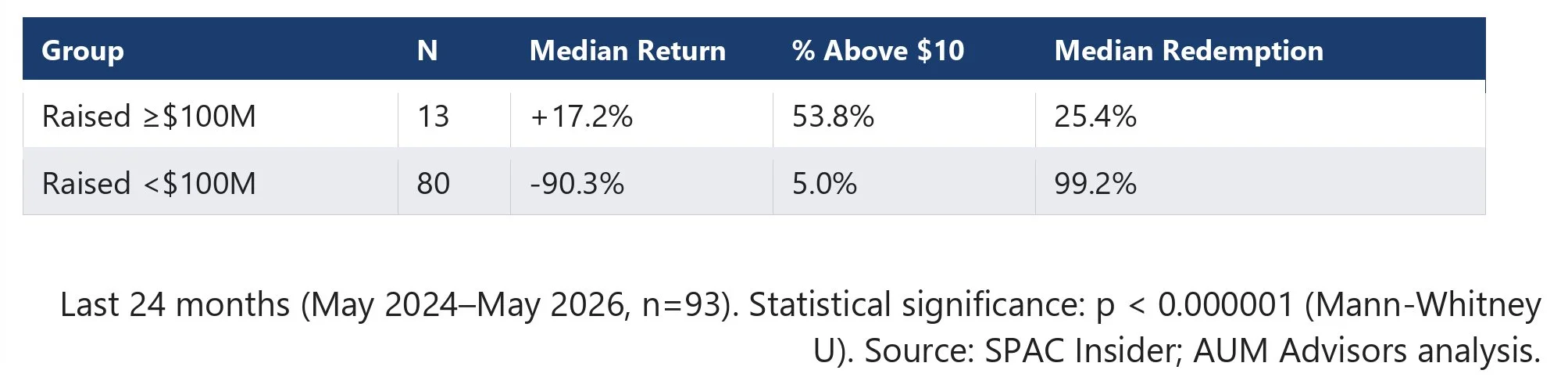
The gap — +17.2% median return for well-capitalized deals vs. -90.3% for undercapitalized ones — is not merely statistically significant. It is operationally decisive. In the last 24 months, a de-SPAC that couldn't attract $100M in institutional capital at close had a one-in-twenty chance of staying above water. A deal that cleared $100M had better than even odds.
The $100M threshold matters for two reasons that are conceptually distinct. First, it provides operational runway: a company with $100M or more in cash can fund its development, meet public company obligations, and survive the first 12–18 months of warrant and PIPE overhang without being forced to raise additional capital at distressed prices.
Second, and more importantly, the ability to attract $100M signals that institutional investors — who could have said no, and who had the option to redeem rather than invest — made an affirmative judgment about the target's quality and valuation.
The Redemption Rate: The Market's Real-Time Verdict
The redemption rate at close is the clearest available signal of institutional confidence. When 99% of trust holders redeem, they are voting — with actual capital at risk — that they would rather have their $10 back than own equity in the merged company. Across all 699 deals in our dataset, the relationship between redemption rate and post-merger performance is monotonically negative:
Every incremental 20 percentage points of redemption roughly halves the probability of the deal surviving above $10. Deals where fewer than half of trust holders redeemed are 4× more likely to still be above their original price than deals where more than 95% redeemed. The TOYO exception — discussed in detail in Part III — is notable precisely because it proves the rule: a company that begins from a position of near-total redemption (99.9%) and survives and thrives above $10 does so through extraordinary execution, not because the redemption signal was wrong. The redemption rate correctly identified the challenge; what it could not predict was the quality of the operational execution, along with IR and communications program that followed.
03 Public Company Operational Readiness
The transition from a private company to a public company is not a graduation ceremony. It is a category change — one that imposes obligations, timelines, and institutional expectations that have ended more than a few promising businesses that were simply not prepared to meet them.
The conventional IPO process, whatever its costs and limitations, has one significant virtue: it forces a degree of preparation. The S-1 registration process, underwriter due diligence, and roadshow scrutiny require management to have their financial house in order, their audit relationships established, and their disclosure policies in place before the first institutional investor writes a check. The de-SPAC process, historically, compressed or eliminated most of these preparatory steps.
The Pre-Closing Infrastructure Build
The companies that succeed as de-SPACs treat public company readiness as a pre-closing build, not a post-closing cleanup. The specific elements are well-defined:
The Custom KPI Imperative One of the most important and least-discussed elements of public company readiness for prerevenue or early-revenue de-SPACs is the development of a custom non-GAAP KPI that gives institutional investors a leading indicator of business momentum before GAAP financials can carry the story. IonQ introduced Remaining Performance Obligation (RPO) — the total value of contracted but unrecognized revenue — as its primary forward-looking demand signal from Day 1 as a public company. D-Wave Quantum introduced "Bookings" and has reported eight consecutive quarters of year-over-year growth in that metric, giving institutional investors a smooth, consistent data series to model through lumpy quarterly GAAP revenue. In both cases, the custom KPI preceded the GAAP inflection by multiple quarters — and that lead time was critical for retaining institutional holders who would otherwise have sold through the GAAP earnings volatility. Companies that wait for GAAP revenue to make their case are fighting with one hand tied behind their back. The custom KPI should be defined, communicated to investors, and reported consistently from the first earnings call as a public company.
04 Robust Investor Communications — Years One and Two
The post-listing period is structurally adversarial for de-SPACs. Warrant holders, PIPE investors, and the SPAC sponsor's founder share lock-up expiry all create predictable selling pressure in the 3–12 months following listing. Retail investors attracted by the merger announcement often sell on the news. Institutional investors, who typically require 90 to 360 days of trading history, successive clean earnings prints, and multiple meetings with management before initiating a position, are not yet present in meaningful size.
The companies that navigate this period successfully do so not by hoping the selling pressure abates, but by executing a disciplined investor communications program that builds the institutional ownership base systematically, creates consistent news flow that sustains narrative momentum, and positions the company for its first significant follow-on capital raise.
01. Custom KPI from Day 1
As discussed in Discipline 3, the custom KPI is both a readiness element and a communications element. It must be introduced on Day 1 and reported consistently every quarter. Investors who have three or four quarters of trend data on a custom KPI will hold through a disappointing GAAP quarter; investors who have only GAAP data and no non-GAAP context will sell.
02. The Execution-Focused Narrative Arc
The most effective de-SPAC investor communications programs build the equity story in chapters — each chapter corresponding to a defined milestone on a published roadmap. Product milestone. Commercial customer win. Government contract. Strategic partnership. Each announcement, properly framed, advances the narrative rather than standing in isolation.
The discipline here is in the framing, not just the timing. A government contract win is not just a contract — it is validation of the technology by a sophisticated, demanding customer with unlimited diligence resources. A Fortune 500 customer signature is not just revenue — it is proof of enterprise repeatability. Investors who understand the narrative architecture of a stock are less likely to sell on individual data points and more likely to hold for the compounding story.
03. Analyst Coverage Cultivation
Sell-side analysts do not cover de-SPACs on listing day. The coverage desert in the first 6–12 months post-listing is a structural feature of the market. Cultivating analyst coverage requires a systematic prospecting campaign: consistent presence at Tier-1 investor conferences, proactive engagement with equity research desks at banks that have relevant sector coverage, and the patience to build the relationships that precede formal initiation.
IonQ entered the public market with no analyst coverage. Today the company has coverage from seven or more analysts, driven by years of consistent conference presence, NDRs, and the credibility built through the beat-and-raise guidance pattern. Each analyst initiation is not just a research event — it typically unlocks three to five fund introductions from that bank's institutional client base. The coverage flywheel, once started, is self-reinforcing.
04. Guidance Discipline: Set Low, Beat Consistently
The single most damaging pattern in bubble-era de-SPAC history was aggressive guidance followed by repeated misses. The credibility destruction from a guidance miss in Year 1 or Year 2 — when the company has no institutional ownership depth to absorb the selling — can take years to repair.
The opposite pattern — conservative guidance that management can consistently beat — has the effect of making every earnings report a trust-building event. IonQ, trading at 80x+ price-to-sales in April 2026, can only maintain that multiple because institutional investors have learned to trust its guidance. Any single quarter of significant miss would trigger a selloff that would take multiple beats to recover from.
05. Warrant and PIPE Overhang Management
The dilution calendar for a de-SPAC in its first year is predictable, and that predictability should be weaponized as a communications tool rather than treated as an embarrassment. Sophisticated institutional investors, the ones who are going to anchor the eventual follow-on offering, can model float evolution, overhang timelines, and dilution scenarios. If management provides them with the data to do so proactively, they will hold through the selling pressure. If management goes silent on the topic, those same investors will assume the worst and sell in advance of what they perceive as a dilution event.
06. Persistent Cultivation of Strategic Institutional Accounts
The final and often most neglected element of Year 1 and Year 2 IR is the systematic cultivation of the 15 to 25 long-oriented institutional funds that are most likely to anchor the company's first meaningful follow-on offering. These are not generic institutional investors — they are the specific funds whose investment mandate, sector focus, market cap range, and portfolio construction logic make the company a natural fit.
Identifying these funds requires IR intelligence — 13-F analysis, sector fund screens, portfolio overlap studies. Engaging them requires consistent touchpoints: quarterly check-in calls, NDRs after significant milestones, in-person meetings at Tier-1 conferences. The relationships built in Year 1 determine whether the Year 2 follow-on prices at or above market, or at a significant discount to current trading.
IonQ's $2 billion equity offering at peak valuation was not a surprise to the institutional investors who participated in it. It was the culmination of two years of systematic relationship building that had already converted them from skeptics to believers.
05 The Compounding Effect
The five disciplines described in this paper are not independent variables. They compound. Institutional-quality target selection makes valuation discipline achievable — better companies attract institutional capital at better prices.
Valuation discipline enables public company readiness; companies that aren't burning through emergency capital can invest in the infrastructure of being public. Operational readiness enables investor communications; companies that report on time, guide conservatively, and beat consistently give IR programs something substantive to communicate. And consistent investor communications builds the analyst coverage and institutional ownership depth that makes followon capital accessible at favorable prices.
Retail Support: Liquidity as a Barrier to Ownership
Coming out of the gate, many de-SPACs have very tight floats. This can sometimes result in massive price spikes at the close, followed by equally dramatic declines. During the first six to twelve months every IR strategy should have a retail component that includes regular news flow, a vibrant social media presence, participation in retail-oriented conferences and webinars, and engagement with financial and trade media. A small circle of close followers who write about the company in venues like Seeking Alpha, StockTwits, Reddit, and Substack can compound into a highly engaged retail audience. Retail enthusiasm is critical because it builds the initial trading volume that opens the door to institutions to consider taking a position as well as stimulating algorithmic trading.
Analyst Coverage: The Research Initiation Flywheel
Sell-side coverage is both an outcome of disciplined IR and a multiplier of it. Each analyst initiation is a distribution event — the initiating analyst's client list typically includes dozens of institutional funds that may not have previously considered the company. For companies that have executed the first four disciplines, analyst coverage is the bridge from the early-adopter institutional base to the broader institutional universe. The prerequisite for analyst initiation is a combination of market cap threshold (depending on their profile, most banks require $250–1B+ in market cap to justify coverage), trading volume, and management credibility (earned through the guidance discipline). Companies that have executed disciplines 1–4 will typically find analyst coverage emerging organically in Year 2; companies that haven't will find it elusive regardless of how many conferences they attend.
Institutional Ownership: The 90–360 Day Window
Most institutional funds have internal policies requiring a minimum period of trading history before initiating a position in a small-cap company. The typical range is 90 to 360 days. This means that for the first three to twelve months of its public life, a de-SPAC's institutional ownership base consists primarily of the PIPE investors who participated in the merger — not the broader long-only institutional universe.
The implication is that Year 1 IR is primarily a prospecting exercise, not a retention exercise. The goal is not to hold the investors who are already in the stock; it is to build the pipeline of institutional funds who will initiate positions in Year 2, once the trading history requirement is satisfied. Companies that understand this temporal dynamic will invest in the relationship-building activities of Year 1 even when they cannot yet see the ownership results.
Follow-On Capital: The Validation Loop
A well-executed follow-on offering at or above the de-SPAC listing price is the single strongest credibility signal available to a recently public company. It demonstrates that institutional investors, who could say no, and who had full information about the company's performance and outlook, chose to buy more equity at the current or higher price. The first 12-18 months of IR activities should be setting up for the moment when the company becomes shelf eligible and can do a well marketed offering to bring in the solid book of institutions that would have come in during a marketed roadshow in a normal IPO.
IonQ's $2 billion equity offering at its 2024 peak valuation illustrates the full compounding effect in action. The offering was oversubscribed because institutional investors who had followed the company through multiple years of consistent guidance beats, custom KPI reporting, and analyst coverage expansion trusted the management team's execution. The offering, in turn, added sell-side coverage from the underwriting banks, broadened the institutional ownership base, and provided the capital runway to sustain the growth narrative for the next three to four years.
The compounding effect is the difference between a one-time winner and a repeatable framework. Strong IR builds analyst coverage. Analyst coverage builds institutional ownership. Institutional ownership makes the follow-on possible. The follow-on validates everything that came before it.
Part III: Case Studies — The Disciplines in Practice
The four case studies that follow illustrate the five disciplines in action across different sectors, capital structures, and starting conditions. Each represents a different aspect of the framework:
TOYO Co. Ltd. — IR quality overcomes near-total capital deficit
IonQ — All five disciplines executed at scale over four years
Symbotic — Discipline 1 (target quality) as the multiplier for everything else
Intuitive Machines — Execution-focused narrative arc in a high-conviction sector
TOYO Co. Ltd. (TOYO) | Renewable Energy Technology | Closed July 2024 | +53% return | Current price: $15.30 | $6M raised at close | 99.9% trust redeemed | AUM Advisors client
The Situation
TOYO Co. Ltd. completed its de-SPAC transaction in July 2024 under conditions that, by every quantitative measure, predicted failure. With 99.9% of trust holders choosing to redeem, the company entered public life with a mere $6 million in cash raised through a PIPE — a fraction of what most institutions consider the minimum viable capital base for a newly public company. In the 24 months prior to TOYO's close, 94% of de-SPACs in comparably undercapitalized situations failed to maintain a price above $10.
What Made the Difference
AUM Advisors engaged with TOYO before the merger closed, building a comprehensive investor relations infrastructure from the ground up: a fully SEC-compliant IR website with investor materials, a narrative framework that translated the company's renewable energy technology into a compelling investment thesis for US institutional and retail audiences, and an institutional communications program designed to establish credibility and consistency from listing day.
In addition to a challenging market for de-SPACs, TOYO faced a dramatic change in the tariff environment shortly after going public that sharply reduced the profitability of its main facility in Vietnam. Fortunately, an exceptional management team was able to rapidly pivot to stand up a new cell factory in Ethiopia and a domestic module facility in Houston, transforming the revenue mix of the company and becoming Japan’s largest solar manufacturer.
Rather than waiting for the operational overhang to clear before engaging with investors, TOYO established a disciplined press release cadence immediately post-listing — creating consistent news flow that sustained narrative momentum through a period when the stock might otherwise have drifted on thin volume. Management was positioned for systematic institutional and retail investor outreach from Day 1.
The Result
TOYO recently traded at $15.30 — 53% above the original $10 SPAC price — with no institutional capital cushion, a minimal PIPE, and no retained trust cash to speak of. It is one of only 17 companies in the post-2022 universe to have achieved and sustained a price above $10 with redemptions above 90%. TOYO is the clearest possible demonstration that investor communications quality and execution discipline are not supplementary to the de-SPAC process. Combined with exceptional execution of the business plan, they can make all the difference.
IonQ (IONQ) | Quantum Computing | Closed September 2021 | +536% return | Current price: ~$63 | $650M raised | 3.2% redeemed
The Situation
IonQ completed its de-SPAC in September 2021 — at the tail end of the bubble era, but with a combination of institutional quality and capital discipline that separated it from the generational cohort. With $650M in combined PIPE and retained trust and redemptions of only 3.2%, IonQ had both the capital runway and the institutional confidence to build for the long term.
The Execution
IonQ's post-listing execution is the closest thing in the de-SPAC universe to a textbook illustration of all five disciplines operating simultaneously. The company introduced Remaining Performance Obligation (RPO) as its primary non-GAAP KPI from the first earnings call, giving investors a contracted demand signal before GAAP revenue could carry the story. Management adopted a conservative guidance framework and has beaten consistently, building the credibility that sustains a 80x+ price-to-sales multiple.
The IR program built analyst coverage from zero to seven or more analysts through systematic Tier-1 conference presence and NDR campaigns. Strategic institutional accounts were cultivated over multiple years, resulting in a 2024 equity offering of $2 billion that was oversubscribed — a credibility event that reinforced every preceding quarter of execution rather than representing a dilutive emergency.
The Lesson
IonQ demonstrates that the five disciplines are not only survival tools — they are compounding value creation tools. The quantum computing sector's strong de-SPAC survival rate (part of the broader Technology cohort) is not incidental to IonQ's success; IonQ's success is in part what created the sector's reputation for institutional quality in the post-merger public market.
Symbotic (SYM) | Warehouse Robotics & Automation | Closed June 2022 | +429% return | Current price: ~$52.87 | $525M raised | 86% redeemed
The Situation
Symbotic completed its de-SPAC in June 2022 — in the early zombie era, when the market was deeply skeptical of de-SPAC transactions. With 86% redemptions and a Zombie-era close, Symbotic faced the structural headwinds of the period. What it had that most of its cohort did not was a genuine, category-leading business: a warehouse automation platform backed by Walmart, with a technology moat, a large and growing commercial pipeline, and a management team that had operated at scale in enterprise technology.
The Execution
Symbotic's primary contribution to the de-SPAC success framework is the illustration of Discipline 1 as a multiplier. The company's business quality — real customers, real revenue, real technology differentiation — made investor communications straightforward because the story was true. An earnings cadence and guidance framework established early in the company's public life created a consistent beat-and-raise pattern that built institutional confidence quarter by quarter.
The Lesson
Symbotic answers the question that skeptics of the communications-focused disciplines often ask: "Doesn't the business quality ultimately determine the outcome?" The answer is yes — but only if the investor communications program creates the conditions for that quality to be recognized and valued by the institutional market. Symbotic had the quality. The communications execution ensured that institutions who might otherwise have avoided a zombie-era de-SPAC came to understand and own the story.
Intuitive Machines (LUNR) | Space Infrastructure | Closed February 2023 | +249% return | Current price: ~$18.97 | $56M raised | 83% redeemed
The Situation
Intuitive Machines completed its de-SPAC in February 2023 with relatively modest capital ($56M) and high redemptions (83%) — not the profile of a company positioned for outstanding post-merger performance. What it had was sector tailwinds (Space is the highest-survival-rate sector in de-SPAC history at 42.9%), a government revenue anchor in the NASA Commercial Lunar Payload Services (CLPS) contract, and a management team that understood how to tell the equity story in chapters.
The Execution
Intuitive Machines is the clearest example in our dataset of the Execution-Focused Narrative Arc as a communications discipline. Each lunar mission — IM-1, IM-2, IM-3 — was a chapter in the equity story: a verifiable milestone, publicly observable, with concrete commercial and reputational implications that institutional investors could model. The IM-1 landing in February 2024 was not just a technical achievement; it was a communications event that demonstrated NASA mission competency to every aerospace institutional investor in the market.
The sequential mission structure allowed management to set expectations, execute visibly, and raise the bar progressively — exactly the beat-and-raise dynamic that builds institutional confidence over time, applied at the mission level rather than the quarterly financial level.
The Lesson
Intuitive Machines demonstrates that the narrative arc discipline can work even in sectors and deal structures where capital is limited, provided the milestones are real, verifiable, and sequenced to compound. The space sector's 42.9% survival rate is not accidental: it reflects the structural advantage of businesses whose milestones are inherently visible, technically credible, and commercially meaningful.
Conclusion: The Selective Case for SPACs
SPACs do not universally work. The data makes that clear. The median de-SPAC has lost 91 cents on every dollar invested by shareholders who chose not to redeem. Eighty-five percent of completed transactions are trading below the original SPAC price. The Electric Vehicle sector alone destroyed billions in investor capital through a combination of sponsor opportunism, valuation inflation, and business model failures that any rigorous diligence process should have identified.
But the data also makes something else clear: 104 companies have used the de-SPAC structure to create genuine, lasting value. The five disciplines described in this paper are consistent across the winner cohort. Institutional-quality target selection. Valuation discipline enforced by institutional market participation. Public company operational readiness built before the close. Robust investor communications executed over at least two years. And the compounding effect of analyst coverage, institutional ownership, and follow-on capital at favorable prices.
The SPAC structure, when applied to the right company with the right preparation and the right post-listing execution, offers something that a conventional IPO cannot: the ability to tell a long-form, milestone-driven equity story to a patient investor base without the quarter-by-quarter scrutiny of a traditional roadshow. For capital-intensive, narrative-dependent businesses in sectors with long development cycles — quantum computing, space infrastructure, advanced manufacturing, sustainability technology — that structural advantage is real.
The firms that will win in the current environment are the ones with the discipline to do fewer deals, for better companies, with the preparation and post-listing infrastructure to see them through. Volume is a trap. Selectivity is the edge.
The SPAC structure offers something a conventional IPO cannot: the ability to tell a long-form, milestone-driven equity story to a patient investor base. For the right company with the right execution, that advantage is real.
About AUM Advisors
AUM Advisors is a senior advisory firm specializing in investor relations, capital markets strategy, and investor communications for international issuers and complex US capital markets situations, including de-SPACs, IPOs, and cross-border transactions. The firm’s principals have counseled management teams on more than 100 IPOs, SPACs, and follow-on transactions across the US, Japan, Europe, Greater China, and Southeast Asia.
AUM Advisors engages only with companies whose business model and governance it can stand behind. Selectivity is a design principle, not a constraint.
Website: aumadvisors.com
Case Studies: aumadvisors.com/case-studies
Contact: Crocker Coulson, Founder & CEO | crocker.coulson@aumadvisors.com | (646) 652-7185
Data Sources and Disclosures
All quantitative analysis in this paper is based on data from SPAC Insider, a specialized research provider covering the SPAC and de-SPAC market, supplemented by AUM Advisors' proprietary analysis. The universe consists of 699 completed de-SPAC transactions through May 22, 2026. Returns are split-adjusted. "Capital raised" is defined as straight equity PIPE (share-based, excluding warrants and convertibles) plus current estimated cash retained in trust at close.
Case study data is drawn from public SEC filings (10-K, 10-Q, 8-K), company earnings releases and investor presentations, and AUM Advisors' proprietary client engagement records where noted. TOYO Co. Ltd. is an AUM Advisors client; all case study content reflects publicly available information unless otherwise noted.
This paper is prepared for informational purposes only and does not constitute investment advice, an offer to sell, or a solicitation of an offer to buy any security. Past performance is not indicative of future results. All returns referenced are historical and do not represent the returns of any AUM Advisors product or service.
© 2026 AUM Advisors, Inc. All rights reserved. AUM Advisors and the AUM Advisors logo are trademarks of AUM Advisors, Inc.