

AUM Advisors Insights
When a PIPE Is Not a PIPE

Structure and De-SPAC Performance
Who This Is For
This study is written for two readers who rarely get the same document:
- the CFO of a private company evaluating a SPAC merger without prior experience raising a PIPE
- the investor — institutional or retail — trying to ascertain whether a newly announced de-SPAC is likely to perform well and survive.
Both readers face the same problem.
When a SPAC deal is announced, the press release will often say the transaction “includes a PIPE.” In 2020, that sentence told you something specific: institutions were buying common stock at the same $10.00 the public paid, with the same risk the public carried. In 2026, the same sentence can mean that — or it can mean a senior convertible instrument whose conversion price resets downward as the stock falls, so that the new investor collects more shares precisely when everyone else is losing money. Same four letters. Opposite economics.
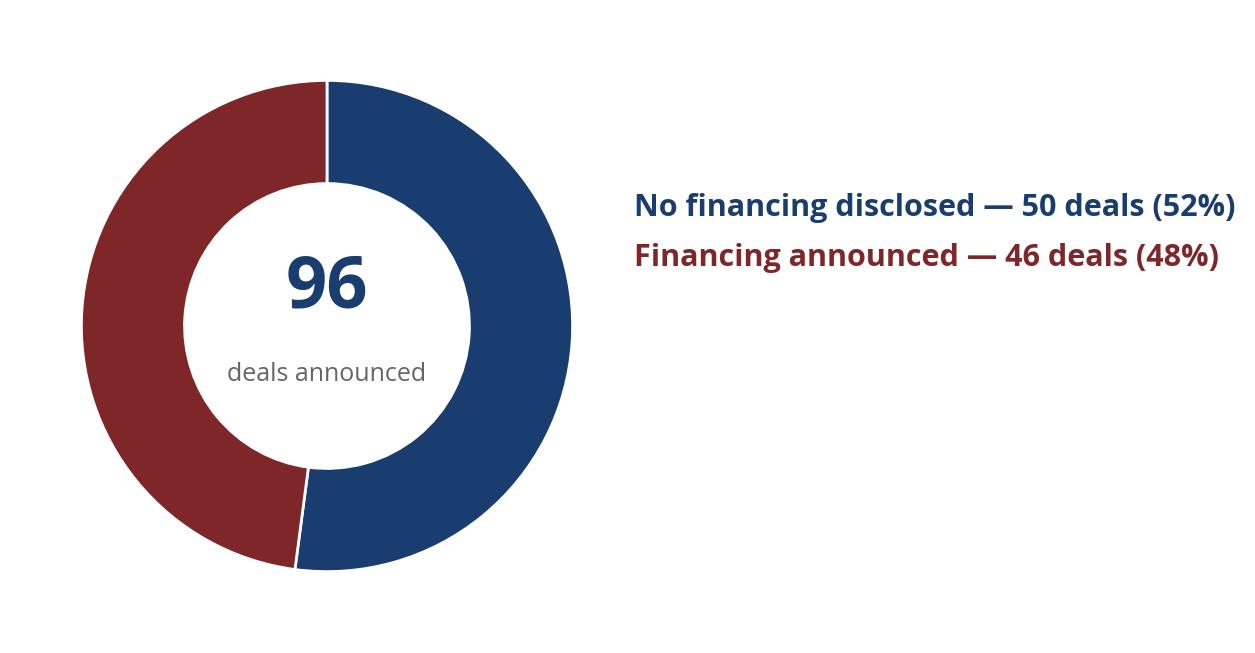
We read the actual financing documents — every agreement attached to the 96 de-SPAC transactions announced in the trailing twelve months, 291 SEC filings in all — and benchmarked them against the 108 mergers completed since the SEC’s current SPAC rules took effect in July 2024. This guide explains what we found, in plain terms first and technical terms second, and ends with the handful of deal points that deserve a company’s hardest negotiation.
Why a De-SPAC Almost Always Needs One
Start with the mechanics that make the PIPE necessary, because nothing else in this study makes sense without them.
A SPAC raises money in its own IPO and holds it in trust. But that money is not committed to the merger — every SPAC shareholder has the right to redeem, taking back their cash plus interest instead of holding shares in the combined company. In the current market, most do. Redemption rates on completed deals routinely run above 90%. A SPAC that raised $250 million can arrive at closing with $15 million.
The merger agreement, meanwhile, usually contains a minimum cash condition: the target can walk away if the deal fails to deliver an agreed amount of money. The PIPE exists to bridge the gap between what the trust promises and what redemptions leave behind. It is the only money in most de-SPACs that is contractually committed rather than free to flee.
That is also why the PIPE carries signaling weight far beyond its dollars. Trust money made its decision two years ago, when the SPAC was a blank check. PIPE money made its decision after reading this deal — the projections, the diligence, the valuation.
When Xanadu Quantum announced a $275 million committed common PIPE, or Freenome $240 million, or Agility Robotics $200 million, the announcements said something no press-release adjective can: sophisticated investors studied this company and wrote checks at the deal price, on the same terms existing public shareholders are being offered. When a deal announces no financing at all — and half do — the silence says something too.
Who Actually Writes These Checks
Five kinds of investors show up in the subscription agreements, and they want different things.
1. Crossover and fundamental institutions — Mutual funds, hedge funds and sector specialists buying the company, not the structure. They take common stock at the deal price and win only if the business performs. Their names in a PIPE are the strongest validation a de-SPAC can buy, which is why press releases lead with them.
2. Structured-finance desks — Specialist funds whose product is the convertible with downside protection: seniority, a coupon, and often the reset mechanics at the center of this study. They are underwriting the structure, not necessarily the story. Their presence is not inherently a red flag, but it tells you the deal could not clear at $10.00 common.
3. Strategics — Corporations investing for commercial reasons: a customer, supplier, or partner of the target. Usually common stock, usually patient, and usually the second-best name a deal can announce.
4. Sponsors and their affiliates — The SPAC’s own promoters backstopping their deal. Real money, but conflicted money — the sponsor’s founder shares are worthless if the deal dies, so a sponsor PIPE is partly a rescue of its own position, and they may be compensated by keeping their full promote shares, which reduces their true basis in the PIPE.
5. Target insiders and existing holders — The company’s own shareholders rolling new cash in. Genuine conviction, but no independent validation because they were already true believers.
The investor-type mix matters more than the headline size. A $100 million PIPE from crossover funds and a strategic is a different deal from a $100 million convertible written by two structured desks — even though both press releases will call them PIPEs.
Nothing Like an IPO Roadshow
A CFO who has read about IPO roadshows should discard most of that mental model.
An IPO is a marketed public sale: a registration statement reviewed by the SEC in advance, a one-to-two-week roadshow, underwriters building a book of orders, standing behind the prospectus with their capital and their liability, and supporting the stock after pricing with a greenshoe. The process is designed to manufacture broad demand at a single price.
A PIPE is sold in private, one conversation at a time. The placement agent “wall-crosses” selected investors — brings them over the information wall under confidentiality, before the deal is public — and shows them the story. There is no public marketing, no SEC review before the money commits, no underwriter capital at risk, and no greenshoe waiting on day one. Every investor negotiates.
This is the asymmetry that produces everything else in this study: in an IPO, demand sets one price for everyone; in a PIPE, each investor can demand terms. If the wall-crossed institutions decline common at $10.00, the placement agent’s phone calls move down the quality ladder — toward the desks that will say yes to nearly any deal, at a structure of their choosing.
The structure of the financing is therefore a fossil record of those private conversations. It tells you, in public documents, what sophisticated money concluded about the deal behind closed doors.
When the Money Shows Up: At Signing or During the Wait
Of the 96 de-SPACs announced between October 2025 and September 2026, 50 — more than half — disclosed no committed financing at all.
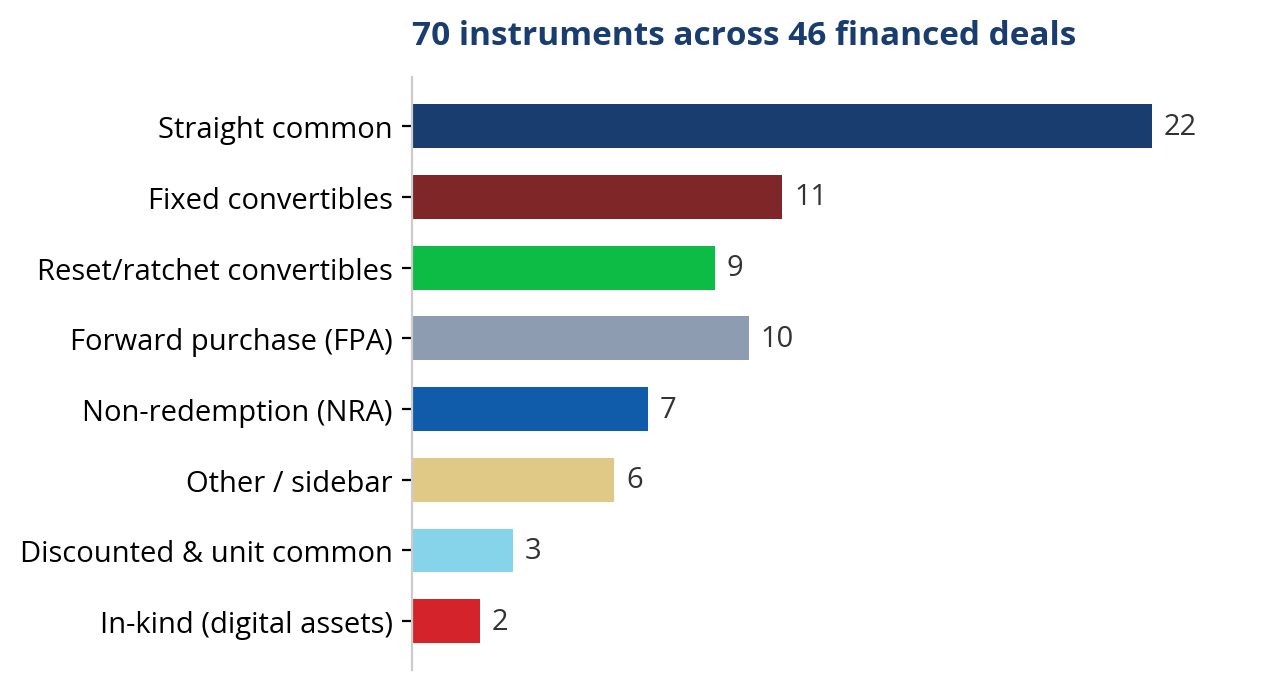
The 46 that did produced 70 distinct instruments, and they split almost evenly on timing: among the deals we can date precisely from their filings, roughly half had financing committed at announcement, and half raised it mid-pendency — a median of 170 days after signing, in one case nearly a year later.
The distinction matters. Financing committed at announcement was negotiated when the company had maximum leverage: a fresh story, a willing sponsor, time on the clock. Financing raised mid-pendency was negotiated under a deadline, often after the market had rendered an early verdict on the deal — and the terms reflect that. Most of the reset instruments in this study were pendency raises. For the investor, a good rule of thumb is to approach the announcement-day press release as the beginning of the financing story, not the end. The instrument that determines your dilution may not be in place yet.
The Five Instruments That Share One Name
Every financing in our census answers one question differently: Who bears the risk if the stock falls after closing? This reflects the unique characteristic of the de-SPAC where the trust value sets a floor beneath the share price until the redemption date, delaying public market price discovery until the merger closes.
Straight common is the original article — shares at the deal reference price, almost always $10.00. The investor owns what you own and loses when you lose. It remains the mark of the strongest deals, and it raised $2.2 billion during this window.
Discounted common is its honest cousin: shares below trust value, but with the concession visible and fixed in a single number.
Convertible preferred and convertible notes with a fixed conversion price give the investor seniority and a coupon in exchange for capital; the dilution is knowable on day one.
Forward purchase agreements commit capital conditionally — and, as we discovered reading their exhibits, sometimes carry repricing provisions of their own.
And then there is the instrument this study is named for: the convertible with a reset.
How a Reset Actually Works
A reset provision re-prices the conversion price downward if the stock falls.
Take this example with round numbers: an investor puts in $50 million of preferred stock converting at $10.00 — on paper, that is 5 million future common shares. The stock drifts to $4.00 and the conversion resets to match. The same $50 million now converts into 12.5 million shares. The company’s share count — and every other holder’s ownership — now floats inversely with the stock price.
A full ratchet goes further: if the company ever sells stock cheaper to anyone, the conversion drops to that price, no matter how small the new sale. The one hard protection common holders have is the floor — the contractual price below which the conversion cannot reset. The distance between the initial conversion price and the floor is the dilution corridor, and it is the single most important number in the document.
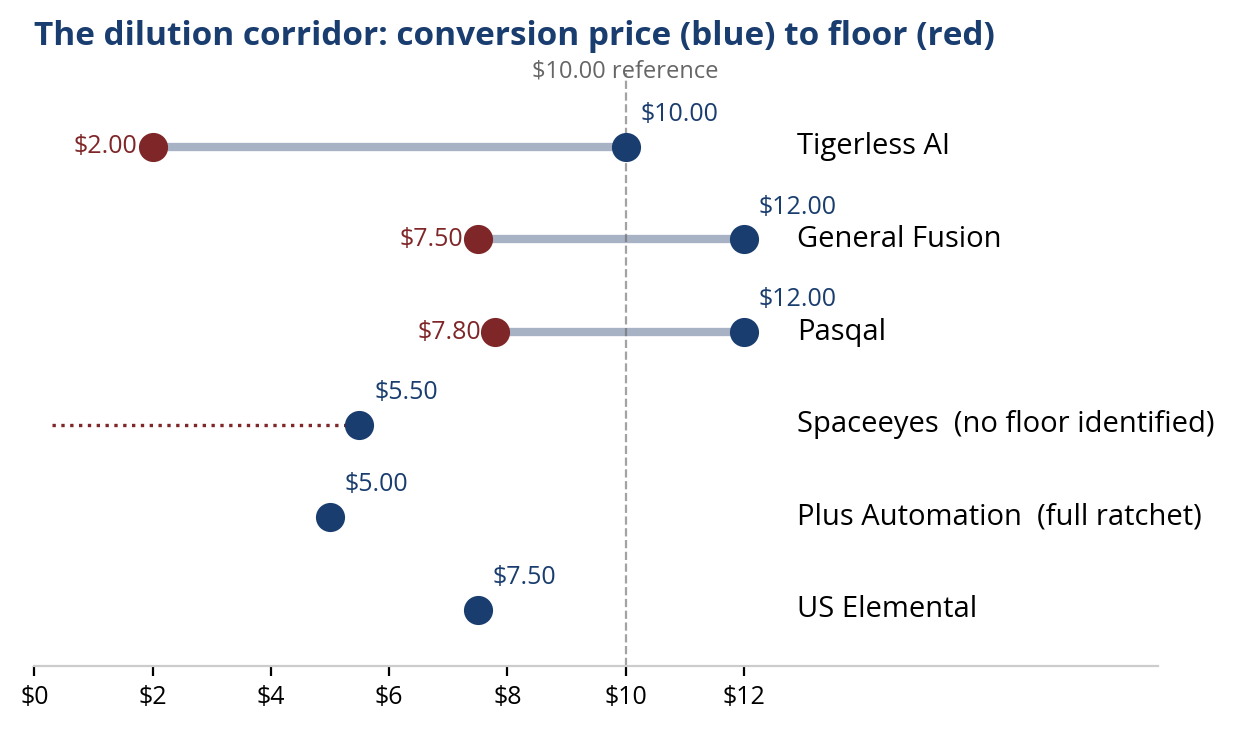
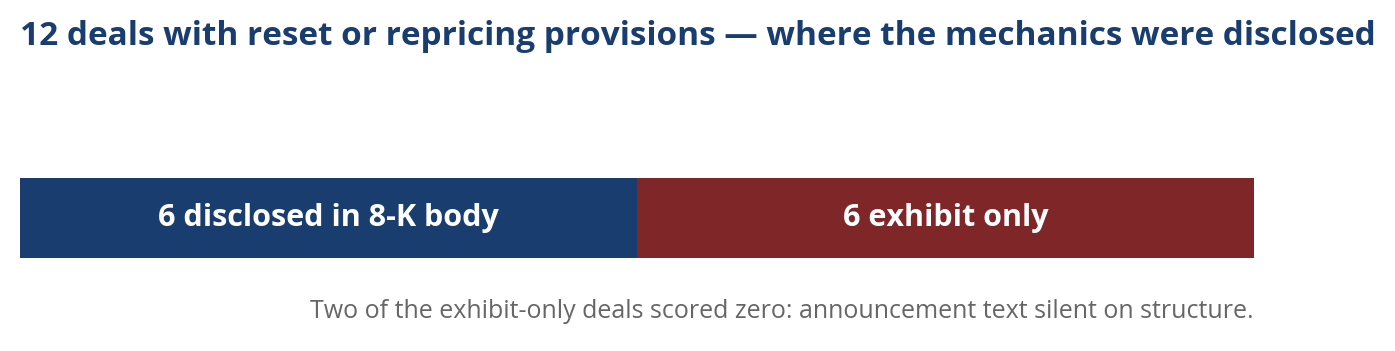
Reading the exhibits of all 46 financed deals, we found reset or repricing language in 12 — roughly one deal in four. Eight are convertibles with conversion-price resets; four more carry repricing provisions inside forward-purchase and related wrappers, where almost no one looks.
The terms span a wide range of candor and severity.
- Pasqal’s convertible note converts at $12.00 with a floor at $7.80 — a tight corridor, honestly priced, with a 10% coupon.
- General Fusion’s preferred offers a $12.00 conversion, $7.50 floor, and 12% coupon.
- US Elemental set conversion and floor at the same $7.50 — effectively a fixed convertible wearing reset clothing.
- Plus Automation took a full ratchet at a $5.00 conversion and disclosed every mechanic in the announcement text, demonstrating that candor and structured paper can coexist.
- At the other end sits Tigerless AI, whose preferred converts at $10.00 and can reset to a floor of $2.00 — an 80% repricing corridor, in a deal announced, accurately but incompletely, as a PIPE.
These mechanics are not always clearly disclosed.
Of the 12 reset-bearing deals, only six mention the reset mechanism anywhere in the body of the announcing 8-K. Two deals score zero on our clarity rubric: the repricing exists only inside an exhibit, with the announcement text silent. Nothing here alleges a violation. Every term is filed, public, and technically available. The question the data poses is narrower and harder: is it reasonable to expect that the average investor could dig up and understand the potential impact of these provisions on future stock selling pressure and dilution?
Where the Truth Lives: A Reader’s Guide to the Filings
Everything in this study came from documents any investor can read without a subscription on the SEC website.
Start at the announcement 8-K. On EDGAR, search the SPAC’s name, filter to Form 8-K, and open the filing dated the day of the deal announcement. Read the body text and then ignore it, because you now know the body may not mention the mechanics. Open the exhibit index. The merger agreement is Exhibit 2.1 and the financing terms live in the Exhibit 10 series — subscription agreements, securities purchase agreements, note purchase agreements, forward confirmations. If the deal includes preferred stock, find the certificate of designations, usually Exhibit 3 or an annex: it is the instrument’s constitution. In those documents, search for four phrases: “conversion price,” “adjustment,” “floor,” and “ratchet.” A few minutes with the search function tells you what the press release did not. If you cannot find a floor in a reset instrument, that is likely a red flag.
Then watch for one more filing after the merger closes: the resale registration statement — Form S-1 or S-3 — that allows the financing investors to sell their shares into the market. Until it is declared effective, structured paper is loaded but cannot fire.
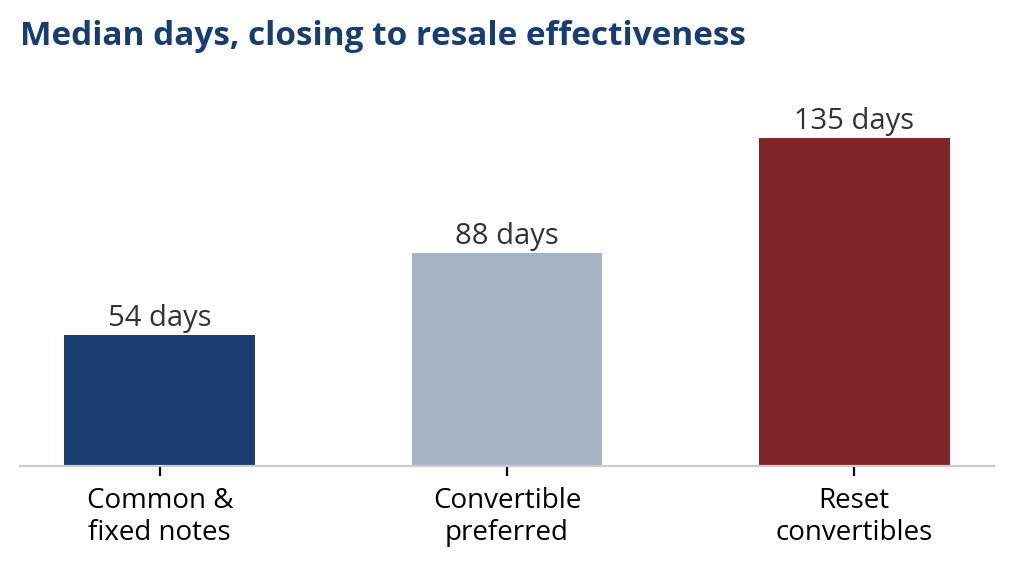
In the cohort of closed deals we examined, resale registrations for common and fixed-note deals became effective a median of 53 to 55 days after closing; reset convertibles took 135. The calendar tells you when the selling pressure becomes possible.
The price record shows what happens when it does. Using weekly FactSet pricing, we tracked all 48 of those deals through the thirteen weeks surrounding their effectiveness dates — six weeks before, six after — benchmarked against the Russell 2000.
In the six weeks after the resale registration went effective, deals financed with convertibles, preferreds, or equity lines lost a median of 17.9%, roughly twice the 7.6% median decline for deals financed with common stock. Adjusting for the small-cap market barely moves the numbers: −16.1% against −9.6%. 77% of the structured deals set a new thirteen-week low within six weeks of the shares becoming sellable, against 64% of the common cohort.
Two details are worth absorbing.
First, the market does not wait for the shares to hit the tape: both cohorts decline into the event, and the median structured deal was already down roughly a quarter from six weeks out by the time its registration cleared. The holders who understand these instruments best are counting the same 135 days you are.
Second, the pattern is gravity, not destiny. When the paper is held by investors who underwrote the business rather than the discount, effectiveness can pass without a ripple.
For the CFO: That calendar is not a doom clock; it is a planning horizon. You know, within a few weeks, the date your structured paper becomes sellable. Spend the interim building the demand side: a disciplined investor relations program that puts management in front of the institutions and retail investors who can absorb the new shares as they hit the tape. Handled early, the unlock becomes something closer to a managed secondary — a liquidity event that deepens the float — rather than a cliff. The companies that treat effectiveness as an IR campaign, not a legal milestone, are the ones whose charts barely show it.
For the investor: The same calendar cuts the other way. When the fundamentals are real and the balance sheet survives its own financing, the weeks around effectiveness are when forced and fast-money selling temporarily overwhelms the order book — and when patient capital gets paid for showing up. A median 18% markdown in six weeks is a warning label on a weak company and an entry point on a strong one. Read the exhibits first, decide whether the business outlives its paper, and only then let the unlock set your price.
The Six Terms to Negotiate Hardest
For the CFO across the table from a structured desk at a hedge fund, the record suggests a clear hierarchy. Everything is negotiable; but these six items have the greatest impact on value.
1. The floor — The worst case for your common holders, in one number. A $7.80 floor against a $12.00 conversion is a financing; a $2.00 floor against $10.00 is an option on your capital structure. Negotiate the floor before the coupon because the coupon is visible pain you can survive; the floor is the hidden kind you might not.
2. Ratchet scope — If anti-dilution protection is unavoidable, fight full ratchet down to a weighted average, and carve out employee equity, strategic issuances, and your ATM. A full ratchet makes every future financing hostage to the first one.
3. The ownership blocker — The 4.99% or 9.99% cap on any single holder’s converted position. It does not reduce dilution — it meters it. A 19.99% blocker, which we found in one deal, is barely a blocker at all.
4. Registration timing — Every additional week between closing and resale effectiveness is a week your stock has a chance to trade on fundamentals before selling pressure dislocates it. The convertible funds push for 30 days; the record shows 135 is achievable on complex instruments.
5. Most-favored-nation and participation rights — The quiet clauses that give the first structured investor the benefit of any better deal you cut later, and a seat at every future raise. They compound. Strike them where you can, and sunset them where you cannot.
6. Issuance consent and variable-rate bans — The leash. Several structured deals in our census require the holders’ prior written consent before the company can issue new securities for as long as the paper is outstanding. One goes further, prohibiting future variable-priced financing except with the fund that already holds the note. Your first structured investor can become the gatekeeper of your second. Every delay, restriction, or concession extracted at that gate comes at the expense of capital you no longer fully control. Negotiate sunset dates, dollar baskets, and carve-outs for board-approved strategic issuances. Otherwise, understand what you are selling: not just securities, but an ongoing veto over how you finance your company.
What the Record Shows
Does structure predict performance?
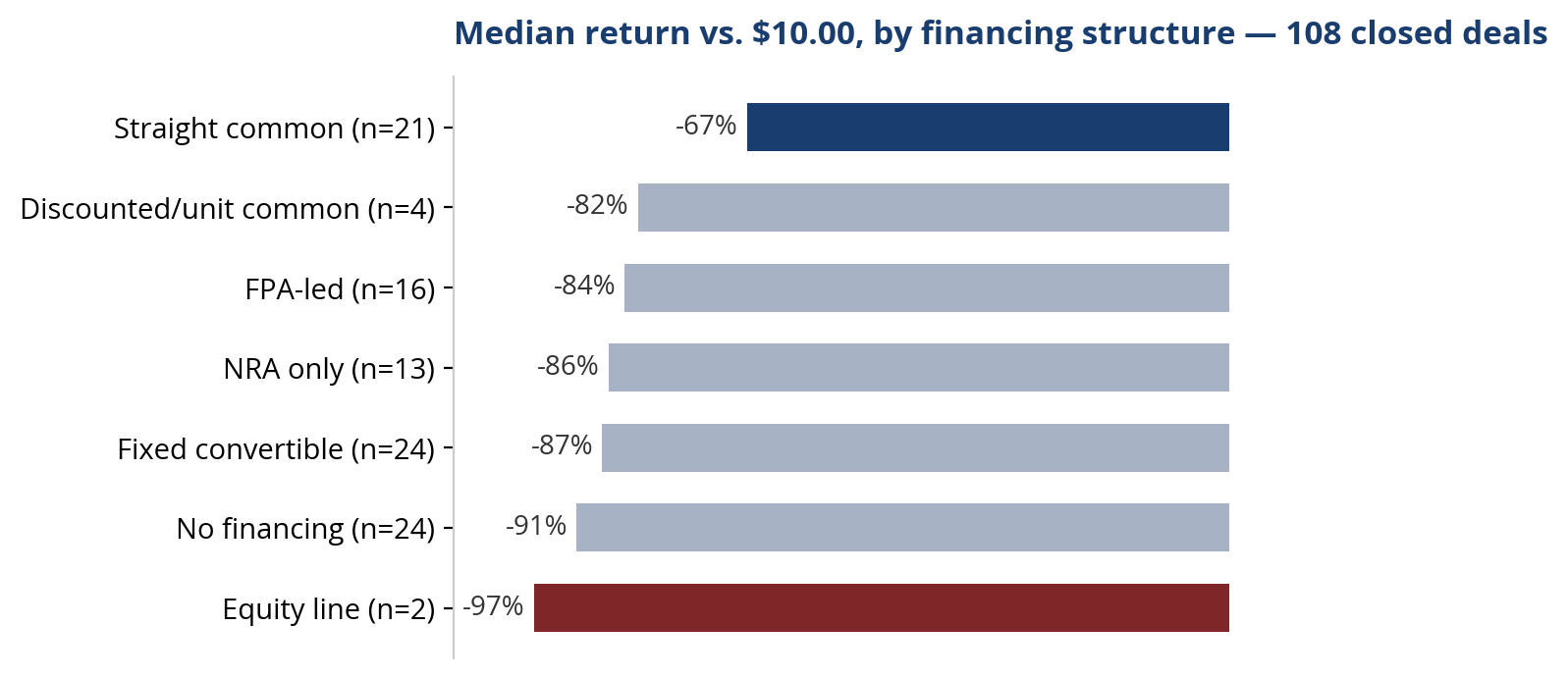
Across the 108 mergers completed under the current SEC rules, the pattern is consistent and the caveats are real. Deals financed with straight common at announcement are the best performers of any financing cohort: a median return of -67% against $10.00, with 19% trading above $10 — roughly double the full universe’s 10% positive return rate.
Fixed convertibles cluster at -87%, forward-purchase-led deals at -84%, deals with no financing at -91%. The two closed deals that leaned on equity lines — Aspire Biopharma and Tactical Resources — have lost essentially everything, a -97% median return.
An equity line commits nothing at signing and sells your stock into a falling market later. For a board, an equity line announced as deal financing should be read as the absence of financing.
What Good Looks Like
Eleven of the 108 closed deals trade above $10.00. That is the honest base rate — about one in ten — and it is why the winners deserve study as well as celebration. These companies made different financing choices.
Freenome is the archetype. The cancer-screening company raised $240 million of committed common stock at announcement — the second-largest PIPE in our census — from crossover investors who bought the deal at the deal price. No conversion mechanics, no floor, nothing that pays off when the stock falls. The deal closed in July 2026, and the stock trades 58% above $10.00. When institutions buy your story at the deal price with no downside protection, the announcement itself is the diligence.
Securitize shows that structure, used honestly, is a tool rather than a trap. The tokenization platform layered roughly $198 million of common at announcement with a $50 million convertible note carrying a fixed conversion price — no reset, no ratchet. The common did the validating; the note did the funding. The stock trades 38% above $10.00. The instrument was never the problem; the repricing engine is the problem.
USA Rare Earth is the counterweight to any claim that preferred paper is inherently toxic. A roughly $49 million convertible preferred funded a deal the market believed. It closed in March 2025 — the longest track record of any winner — and trades 26% above $10.00. Credible terms in a believed story beat pristine terms in a doubted one.
The unlock data hands these deals a second distinction: their registrations did not matter. In the six weeks after Freenome’s resale registration went effective, the stock rose 29%. Securitize rose 41% after its own. When the paper is held by investors who underwrote the business, the day their shares become sellable is a calendar entry, not an event. That, not the absence of structure, is the real tell.
And one pattern holds across all eleven winners: not one carried reset paper or an equity line.
The Bottom Line
For the CFO: Simply securing a “PIPE financing” will not ensure you have stable funding in place for your first 18 months as a public company, and neither will the coupon comparison your banker shows you. Read the floor, the ratchet, the blocker, the registration clock, the MFN, and consent terms — and remember that the deals that disclosed their structures plainly paid no visible penalty for candor.
For the investor: A few minutes invested in examining the exhibit index tells you more than the press release ever will.
And for both: A PIPE that has been twisted into enough strange shapes is still called a PIPE. That does not mean it will carry water.
Sources: SEC filings (291 documents reviewed), SPAC Insider, AUM Advisors analysis. Market prices as of October 11, 2026. This study follows The Five Disciplines of De-SPAC Success, the quarterly De-SPAC Scorecard, and Everything Is Negotiable, our review of every H1 2026 merger agreement.