

AUM Advisors Insights
Everything Is Negotiable
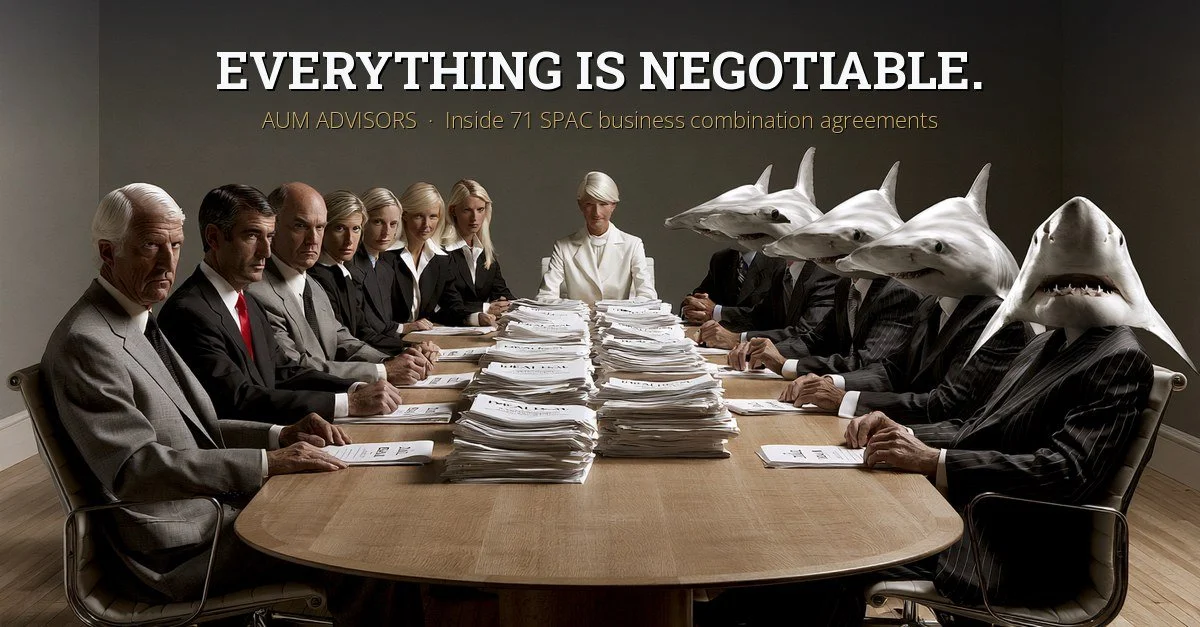
What 71 SPAC Deals Taught Us About the Business Combination Agreement
We read the business combination agreements. All of them.
Every de-SPAC that closed in the first half of 2026 — 24 transactions — plus the signing terms of all 47 deals announced and pending. The BCAs, the sponsor support agreements, the subscription agreements, the amendments, the proxies, the closing 8-Ks. Here is what the record says to any company considering a SPAC merger: every term you think is fixed is not.
The promote is a budget, not a fee
The sponsor promote — those founder shares acquired for a nominal sum — is where target-side negotiation has advanced the most. In H1 2026 alone, we counted ten distinct promote structures in closed deals:
→ In StablecoinX’s combination with TLGY Acquisition, the sponsor exchanged 100% of its founder shares and private warrants for a flat 3% of the post-close company — converting a fixed promote into a percentage and shifting all dilution risk off the target.
→ In Infleqtion’s merger with Churchill Capital Corp X, sponsor shares vest only if the stock holds $12.00 — and are forfeited after five years if it doesn’t. Nothing is earned for merely closing. Infleqtion closed in February with roughly 100% of a $416 million trust intact.
→ In the IQM Quantum Computers–Real Asset Acquisition combination, the sponsor’s warrant forfeiture runs on a formula: all 3,725,000 warrants forfeited if trust proceeds are $100 million or less. Above that, the sponsor keeps warrants in proportion to remaining trust (÷ $175 million). The promote mechanically absorbs the cost of the vehicle’s own redemptions.
→ In Teamshares’ merger with Live Oak Acquisition Corp. V, the promote became deal currency — contractually split so the sponsor could spend founder shares to buy PIPE participation and non-redemption commitments, with 50% of unspent incentive shares forfeited at close.
→ And in Boost Run’s combination with Willow Lane Acquisition, we found the market price of a promote: a seller-affiliated vehicle bought 27.5% of the sponsor’s founder shares and warrants at $1.75 per founder share. Seventeen and a half cents on the $10.00 dollar.
If a sponsor tells you the promote is standard, the 2026 filing record disagrees — ten times over.
Financing: the committed PIPE is now the exception
Here is the number that should reframe every board conversation: of the 47 de-SPAC transactions announced and pending at mid-2026, only 6 disclosed a committed PIPE at announcement. The sign-first, raise-during-pendency model is now dominant.
The closed cohort shows what that means in practice. Deals that signed with committed common PIPEs at $10.00 — Infleqtion ($126.5M), Securitize with Cantor Equity Partners II ($225M), Xanadu Quantum Technologies with Crane Harbor ($275M), IQM ($134M, upsized to $146M with Finnish pension insurer Ilmarinen joining) — kept redemptions lowest and closed on announced terms.
Deals that signed without committed capital paid for it somewhere: one repriced from $1.8 billion to $1.35 billion pre-money to get its PIPE done; another sold 12% cumulative convertible preferred; Teamshares priced its PIPE at $9.20 against a ~$10.54 redemption value — an honest market-clearing price that bought certainty. Risk gets priced — in the headline number, the coupon, the warrant coverage, or the discount. The only question is which currency the target’s board prefers.
And the cheapest redemption defense we found in the first half cost nothing: Boost Run announced a $1.44 billion Dell Technologies agreement and NVIDIA Exemplar Cloud status in the two weeks before its redemption deadline — and closed with zero redemptions and no PIPE at all, delivering 100% of Willow Lane’s $133.8 million trust.
The minimum cash condition has changed jobs
Disclosed minimum cash conditions in H1 2026 closings ran from $20 million (Hadron Energy–GigCapital7) to $150 million (both Xanadu and IQM) — and every one counted trust plus financings. That single drafting convention is why mass redemptions no longer kill deals: Teamshares publicly confirmed its $120 million condition was satisfied by the PIPE alone; another deal closed with 153,830 public shares remaining.
The best drafting we found was also the least round number: Presidio Production’s merger with EQV Ventures carried a minimum cash condition of exactly $140,197,687 — built from an actual uses-of-funds schedule rather than marketing optics. A formula-derived condition is much harder to pressure into a waiver.
The most creative was Suncrete’s: if Available Cash at closing fell below $250 million, the seller’s preferred units automatically exchanged into 9% convertible perpetual preferred instead of being cashed out. The shortfall waterfall was agreed at signing — in paper, not in a panic.
Time runs against the sponsor — put that in writing
A SPAC approaching its deadline has negative leverage, and sophisticated targets contractualized it. In one 14-month European biotech deal, each amendment moved terms toward the target: the first extension eliminated the target-payable termination fee entirely; the second increased the consideration, removed the net tangible asset requirement, and extracted a sponsor forfeiture of 200,000 shares and 400,000 warrants — for no consideration.
The first half also produced something we expect to be copied: in Enhanced Group’s combination with A Paradise Acquisition, a sponsor-payable reverse termination fee — up to $4,875,000 owed by the sponsor side if the deal dies from SPAC-side willful breach. The old assumption that break fees run only one direction is no longer supported by precedent.
Not every clock ran in the target’s favor.
The longest pendencies of the cohort — 20 and 22 months — ended with ballooned convertible sponsor notes, value flowing to closing-date compensation packages, and in one case legacy public shareholders and sponsor holding a combined 0.55% of the company. We are not naming those deals; the patterns matter more than the parties. But they are why the list below exists.
The deal points that rarely make the BCA press release
The announcement PR covers valuation, PIPE size, and strategic rationale. The terms that determine who actually bears risk live in the exhibits. If you are a first-time target management team or board, these are the seven points most likely to be waved through as “industry practice” — and every one was negotiated differently by someone who closed in H1 2026:
1. Sponsor promote vesting and forfeiture. Not whether — how. Flat forfeitures, performance vesting, and trust-indexed formulas all closed this year. The default (sponsor keeps everything for closing anything) is the one structure you should not accept.
2. Convertible sponsor notes. The quiet promote-expansion channel during a long pendency. One 2026 BCA banned them outright without target written consent. Ask why yours doesn’t.
3. What the minimum cash condition counts — and who can waive it. Trust plus financings, company-side, waivable only by you, built from your uses-of-funds schedule. A round number chosen for optics is an invitation to waive it later.
4. The financing window. If the PIPE isn’t committed at signing, the BCA should say who controls its price, structure, and seniority. One 2026 deal wrote the window into the agreement itself; most leave it to leverage.
5. Deferred underwriting fees and affiliate fees. The SPAC’s IPO bankers hold a claim on the trust — waivable, reducible, or convertible to equity, with filed precedent for all three. Where the sponsor’s affiliate is also the placement agent, those fees are promote by another name. Demand the full sponsor-side economics schedule at the LOI stage — and certainly before you sign the BCA — not in the proxy.
6. Extension pricing. Every extension request is a repricing event. The 2026 record includes termination fees negotiated away, consideration increased, and sponsor shares forfeited as the price of more time. If your BCA is silent on what an extension costs the sponsor, it costs them nothing — and you everything.
7. A break fee that runs both ways. Target-payable termination fees are legacy boilerplate. A sponsor-payable reverse termination fee closed this year. It is now precedent.
None of this is exotic. All of it is in the public record — if you know where to look and what to compare it against.
AUM Advisors maintains the complete deal-point extraction across all 71 H1 2026 de-SPAC transactions — every promote structure, financing posture, minimum cash condition, fee treatment, and signing-to-close amendment, with filing citations. If your company is evaluating a SPAC combination or renegotiating one in progress, contact us for a benchmark review of your term sheet against the current market record.